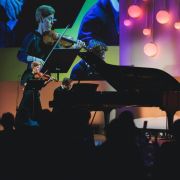
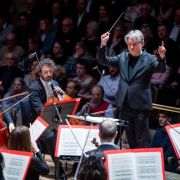
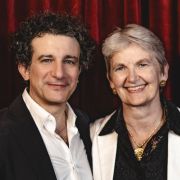
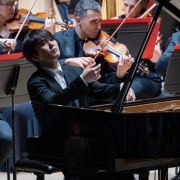
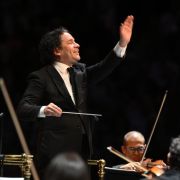
There were deep-rooted transatlantic connections to the programme which Frenchmen Alain Altinoglu and Gautier Capuçon brought to a packed Royal Albert Hall, connections that also spanned the canyons dividing the Romantic and the modern, and the erotic from the cerebral. The connecting tissues were an amalgam of the sensuous, the colourful and the concrete – both figurative and material. They formed the substance of the fabulous playing that Altinoglu elicited from the BBC Symphony Orchestra, both in miniature and in gargantuan formation.

Altinoglu’s reading of Debussy’s Prélude à l'après-midi d'un faune, definitely Old World but also modern and certainly erotic, didn’t show us the faun stretched out on a Thracian plain but languid in a secluded corner of a woodland dappled by sunlight and caressed by fragrant breezes. Pleasure and its anticipation is in the head, but conductor and orchestra knew how to make us suspend disbelief. That sense of showing but not telling was also at play during Dvořák’s Cello Concerto in B minor, a work suffused with passion of another sort; a barely suppressed longing for the inner and outer delights of Old-World home-turf, conceived among the alien corn of the New World. Gautier Capuçon’s fine touch, fulsome legato phrasing and theatrical broad strokes was indicative not just of his love for the piece, but of making us complicit in his devotion.


In terms of sound worlds, the works bookending the programme – Stravinsky’s Symphonies of Wind Instruments and Varèse’s Amériques – are clearly more than oceans apart from the pre- and post-interval pieces. The former, written in France, acquired a US passport in 1947 when it was re-cast into the version played here; the latter, although composed by someone born in France, could only have been produced in America. Altinoglu conducted Stravinsky’s band of woodwind and brass as though it were a superior kind of court orchestra, whose elegant playing was for the delight of visiting dignitaries; the closing verse bore the stamp of civility and refinement.

Varèse liked to think of himself as his own ancestor but was sufficiently conscious of a wider and deeper artistic inheritance to the extent of being able to whistle a few phrases from The Rite of Spring. Whatever he may have said to link New York’s skyscrapers with Amériques, the work is not a picture of a particular place. It is an idea of a place; its compositional scope and structure is not that of a particular symphonic work, but a conception of a piece realisable only in performance – in every performance. As a joint project of Altinoglu and the BBCSO, it rose majestically from the pages of the original score, complete with the haunting of the other-worldly off-stage brass chorus. The elements from which it has acquired a certain notoriety were not merely loud noises but wave after wave of pulsating acoustic and harmonic showers. Before it began a few people made a dash to be first in the queues for buses, trains and tubes, thus missing a stellar performance from both orchestra and conductor.