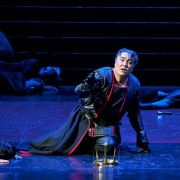
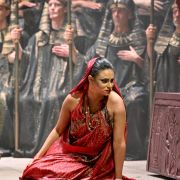
Opening The Royal Opera’s season, Kasper Holten’s staging of Don Giovanni spins around for its sixth revival. Spin being the operative word. It involves a revolving two-storey set by Es Devlin and busy videography effects by Luke Halls which risk over-stimulation, characters up and down staircases as if trapped in an animated Escher installation.

The projections provide glimpses into the Don’s mind, scrawled names of his victims – ‘conquests’ in his imagination – gradually filling every space on the house’s façade during the overture. The events that take place during his doomed final day are also spun as Giovanni’s interpretations: Donna Anna clearly relishing their tryst so much that she sneaks off with him for another bout during Don Ottavio’s first aria; Zerlina ripping her bodice, mussing her hair and crying rape before he has laid a finger on her at the party.


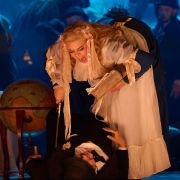
Inkspots and splashes of blood abound, gradually staining Donna Anna’s dress – her reputation – while projected red flames briefly resemble an advert for heartburn tablets. Jean-Paul Sartre deemed that “Hell is other people”, but for Holten’s Don, hell is quite the opposite: a lonely vacuum where his catalogue of conquests are gradually wiped from the slate, all the colour drained from the white set.
Originally (2014), this show ended with Giovanni all alone, a little boy lost, cowering while a snippet of the moralising final sextet was sung from the pit. In every revival, that entire epilogue has subsequently been cut, which rather misses the point about the Don being defined by his libidinous actions. Here, he is permitted one final note of defiance before the lights go out.

Gordon Bintner’s rakish Don was certainly defiant; a testy tinder-box who can also turn on the charm. Bintner sang in this production at Canadian Opera Company two years ago and looked completely at ease here. His baritone both snarled and seduced, the Champagne Aria a manic trip, his Serenade cooing, despite baritone and mandolin briefly going their separate ways. Roberto Tagliavini provided the perfect comic foil as Leporello, very much relishing the buffo aspects of the role. His Catalogue Aria was a highlight, his rounded bass well projected.

Rachel Willis-Sørensen sang a scorching Donna Anna here in 2018; her top notes are less secure now and her coloratura in “Non mi dir” was tentative, What has grown is her dramatic interpretation, biting into recitatives. House favourite Aigul Akhmetshina made her role debut as Donna Elvira. I’m not convinced she’s a natural Mozartian, at least not in this soprano role. She initially seemed to be reining in her voluptuous mezzo, until a fiery “Mi tradì quell'alma ingrata” which impressed.


Giulia Semenzato sang sweetly as Zerlina, “Vedrai carino” being especially silky, vocally caressing Dingle Yandell’s sturdy Masetto, his house debut. Andreas Bauer Kanabas’ sepulchral bass was superb as the Commendatore, destined to spend much of the evening stalking the set/Giovanni’s mind.

The best singing of the night, though, came from Bogdan Volkov as Don Ottavio. Usually the opera’s most annoying character – “I know your father’s just been murdered, but it’s time to move on, I have needs too” – it’s impossible not to fall for Volkov’s honeyed tenor and wide-eyed innocence. His “Dalla sua pace” was pure class, almost ethereal in its beauty, while “Il mio tesoro” was sung boldly, with heroic decorations in the second verse
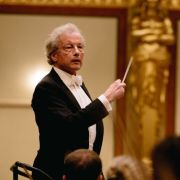
Stefano Montanari conducted a vibrant, pacy account, the orchestra responding with the vim and vigour of freshly-scrubbed pupils facing a new school term, their impetus propelling this satisfying revival.