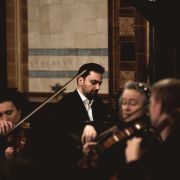
This concert, the third in a weekend of five events presented by Music in the Round with the overall title ‘Percussion, Patterns and Primes’, gave Ensemble 360’s four string players, resident pianist Tim Horton and guest bassoonist Ursula Leveaux the opportunity to consider just some of the ways in which composers have explored the relationship between music and things mathematical. From Machaut’s 14th-century palindromic Ma fin est mon commencement to the contemplative mirror images of Pärt’s Spiegel im Spiegel over 600 years later, this was a concert that ranged widely across genres and historical periods, the seven different composers being linked by works whose structures are governed by matters of symmetry and proportion – or, in John Cage’s case, not.


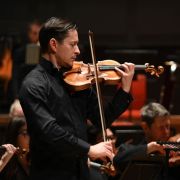
Broadly, one might categorise the pieces performed into those that are part of the mainstream canon of Western music, and (if the term is shorn of any pejorative connotations) musical novelties. The most substantial work was Bartók’s String Quartet no. 4, here given a full-blooded performance by Ensemble 360’s strings. It’s an extraordinary piece, its five-movement symmetrical ‘arch’ structure pivoting around the central slow movement, in Bartók’s characteristic ‘night music’ vein. The musicians were as alive to the folk music roots of the quartet as they were to its more cerebral qualities and the work brought the evening to a compellingly visceral as well as satisfyingly intellectual conclusion.
Two other pieces regularly heard in concert gave Horton the opportunity to display his impressive technique. With its watery impressionism, Debussy’s Reflets dans l’eau might seem quite the opposite of music of strict mathematical patterns, and it is perhaps not necessary to grasp that its structural elements are organised according to the golden ratio. Horton gave equal weight to the gloomy aquatic depths of the left-hand writing as to the sparkling liquid colours of the right-hand. In Pärt’s Spiegel im Spiegel, taken at a somewhat faster pace than one might be used to, he kept the bell-like tolling of the piano part in rigorous order, while Gemma Rosefield’s playing of the beguilingly simple cello line was mesmerically beautiful.


As for the musical curiosities, the Machaut might have benefited from having the words of the text included in order to appreciate its spiritual meaning as much as its musical rhetoric. But the short In Nomine by the virtually unknown 16th-century Robert Picforth, which followed it here in an arrangement for string quartet and bassoon, was revelatory. Its interlocking melodies, in which each instrument plays notes of only one duration, and each a different duration from the others, produced an effect akin to hypnotic 1980s Minimalism.
There were two works probably by Mozart on the programme. In the ‘party trick’ Der Spiegel, Benjamin Nabarro and Claudia Ajmone-Marsan played a work in which one read from the top of the score downwards, while the other, simultaneously, played from the bottom of the score to the top. If that was a novelty, Mozart’s Bassoon and Cello Sonata, in which Leveaux was an eloquent soloist while Rosefield supplied the basso continuo role, was scarcely less of one, at least when it comes to appearances in concert. Meanwhile, in Cage’s Music of Changes (Book One), the composer attempted to answer the question of what happens if all musical decisions are left to chance. Horton played the solo piano part with what appeared to be meticulous precision, but what was interesting about listening to it was the extent to which the human mind wants to impose patterns on the apparently random play of chance.