The annual Sheffield Chamber Music Festival has made regular use of the Samuel Worth Chapel, embedded deep in the leafy heart of Sheffield General Cemetery, for early morning concerts over the years. This year the festival added a ‘Sunset’ concert featuring Ensemble 360 in works by Mozart, Weber and Korngold. The chapel offers really intimate listening – an audience of around 60 encircling the performers – in a brightly resonant acoustic, all hard surfaces and no soft furnishings. With due respect to Ensemble 360’s string players, the event showcased the group’s oboe, clarinet and piano soloists to hugely impressive effect.

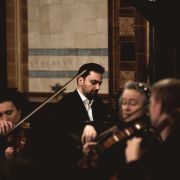
Adrian Wilson has been Ensemble 360’s oboist since the group was founded in 2005. His playing of Mozart’s Oboe Quartet was a delight, whether in the playful exchanges with Benjamin Nabarro’s violin in the opening movement or in the overtly concerto-like Rondo that closes. But as Wilson said before the performance, the heart of the work is the 28-bar second movement Adagio, and here he exploited the oboe’s singing tone in this powerfully moving D minor aria.


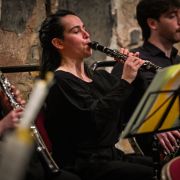
Shadows pooled in the corners of this candle-lit venue as Robert Plane’s clarinet took centre stage for Weber’s Clarinet Quintet. The crepuscular gloom suited particularly well the quintet’s rather theatrical Fantasia second movement, Plane’s playing embracing the full range of the clarinet’s capabilities. For the most part this movement exuded an air of melancholy brooding, but – a clear indication that in the decades between Mozart and Weber popular taste demanded self-conscious displays of virtuosity from the soloist – Plane was more than equal to the pair of three-octave chromatic scales, one fortissimo, the other pianissimo, that flit across the work’s texture in a single dizzyingly quick breath. Elsewhere, the quintet plays to the crowd in its showy good humour, in the droll dialogues between clarinet and Gemma Rosefield’s cello in the Capriccio presto minuet, and in the galloping rhythms of the Allegro giocoso last movement. It’s hard to take this work too seriously, and Plane foregrounded its dazzling wit throughout, but underpinning the surface sparkle was playing of astoundingly fluent technique.

By the time we reached the last work of the evening, Korngold’s Piano Quintet in E major, it was virtually dark outside, shadowy outlines of trees just visible beyond the flickeringly illuminated windows of the chapel; inside, the players’ desk lamps sharply lit up their scores, while audience members beyond them shaded into invisibility. The burden of Korngold’s piece was largely borne by pianist Tim Horton, the only other ever-present member of Ensemble 360 since 2005. But more than either of the other two works on the programme, this is truly an ‘ensemble’ piece, and now the strings were no mere background scenery but characters in the action in their own right. It’s astonishing that this composition is not better known and more frequently performed, given its exceptional qualities, but as advocates for its late-Romantic merits these performers could surely not be bettered. The venue played its part, no doubt, its resonance suffusing the playing with an additional bright halo of sound, but that would count for nothing were the performance not as totally committed as this one was. At its core was the tender Adagio, a set of free variations on one of Korngold’s Songs of Farewell, and a love song to his wife-to-be. Horton and the quartet of strings began the movement in dream-like raptness, but the emotional arc of the journey through deep introspection and towards a luminous if unresolved conclusion unfolded to compelling effect.