Charles Gounod’s grand opéra Faust, which premiered in 1859, remains the most enduringly popular and successful musical adaptation of Goethe’s play. The Teatro alla Scala presents a compelling new production of Gounod's work to close out its 2025-26 season, marking 16 years since the opera was last staged on this historic platform in 2010.

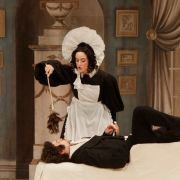
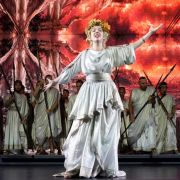
Director Johannes Erath offers a strikingly dreamlike interpretation of the familiar tale, building his visual universe around motifs drawn from the circus. Dancers and acrobats frequently populate the performance space; they serve to enliven the large-scale crowd scenes, or represent church clerics swinging dynamically from bell ropes. The stage set (Heike Scheele) relies on a prominent semi-circular back wall fitted with opening window frames. Video projections by Bibi Abel cast atmospheric black-and-white images of a grand auditorium (perhaps referencing La Scala itself) across the background. Positioned in the middle of the background stands a circular proscenium bordered with glowing circus-style light bulbs, behind which various interior and exterior scenes materialise.


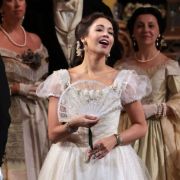
Visually, the production offers magnificent moments, most notably during the ‘kermesse’ and the captivating Act 2 waltz, where the dizzying feeling of a ‘tourbillon’ is captured with genuine theatrical charm and exhilaration. However, this overarching circus concept proves far less effective in the psychological treatment of individual characters. Marguerite is reimagined as a tightrope walker, clad in a white tutu and walking with a deliberate, balanced gait while carrying a delicate white parasol. Her hair is bright red and styled into a tall, improbable shape reminiscent of Aunt Selma from The Simpsons. While her wire-walking routines can be symbolically interpreted as Marguerite attempting to balance herself precariously between salvation and damnation, as the narrative gravity deepens, this whimsical appearance proves increasingly difficult to reconcile with the character's devastating tragic trajectory. Furthermore, Marguerite is burdened by one of modern operatic staging’s most tiresome tropes: the onstage double. After decades of watching competent, innocent dancers mirror a principal singer's every movement while wearing identical costuming, one has largely lost the patience to decipher what such visual redundancy is intended to mean.

In the orchestra pit, Daniele Rustioni explored every subtle colour and nuance of Gounod’s rich orchestration. He placed proper emphasis on the score's inexhaustible melodic invention – the true engine of Gounod’s opera – while offering robust and reliable rhythmic support during the large ensemble numbers. Particularly admirable was his fearless approach to the opera's most bombastic passages, such as the famous martial chorus “Gloire immortelle” in Act 4, a piece where conductors easily lose stylistic poise. Rustioni and the La Scala Orchestra succeeded in making the auditorium tremble without ever sacrificing elegance, dynamic contrast or refined phrasing. Meanwhile, the legendary La Scala Chorus brought Act 2 to vibrant life with tremendous fizz, precision and theatrical energy.

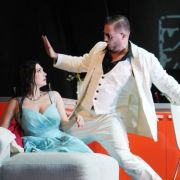
The undisputed star of the evening was Alex Esposito as Méphistophélès. A consummate singer-actor, he effortlessly stole every scene in which he appeared, utilising sleek physical movements, booming laughter, evil grins and incredibly expressive eyebrow work. Crucially, his theatrical antics never interfered with his vocal output: his velvety bass-baritone was grounded in flawless technical discipline, featuring nonchalant top notes and resonant, booming lows. His show-stopping rendition of “Le Veau d’or” was spectacular, featuring him leaping across the stage in a ringmaster’s uniform as Rustioni whipped the orchestra into a frantic frenzy, keeping the entire ensemble balanced perfectly on the knife-edge of theatrical madness.


Vittorio Grigolo’s tenor proved loud rather than lyrical, yet his enthusiastic interpretation remained persuasive. Rather than relying on physical aging makeup in the opening act, he cleverly altered his vocal production to mimic frail old age, injecting a slight nasal placement and exaggerating his vibrato. This artistic choice was remarkably effective because it was not overdone. His natural exuberance suited the rejuvenated young Faust later on, even if a few of his extreme high notes sounded somewhat pushed.

As Marguerite, Marina Rebeka seemed slightly tentative in Act 2, whitening her vocal timbre to portray the naive young maiden. Her coloratura and trills in the Jewel Song were crisp, and her high notes sounded full, despite occasionally sharp intonation likely attributable to premiere nerves. By Acts 4 and 5, her full-bodied soprano flourished, allowing her to unleash the full dramatic weight of her instrument for an emotionally charged finale.
Valentin was one of the singers ill-treated by the director, who dressed him as a ridiculous Pierrot holding a balloon on a string. Baritone Ernesto Petti nevertheless sang admirably; his death scene, in particular, was dramatic and moving. Marcela Rahal stood out as Siébel, delivering a velvety, bronzed mezzo-soprano and singing “Faites-lui mes aveux” in Act 3 with sweet charm and meticulous precision. Finally, Xhieldo Hyseni as Wagner and Hyeonsol Park as Marthe completed the cast, contributing solidly to the ultimate success of the performance.