The Rossini Opera Festival presents a new production of Le Siège de Corinthe – the first opera Gioacchino Rossini wrote in French for Paris – marking the 200th anniversary of its premiere. A critical edition by Damien Colas, previously used at the ROF in 2017, formed the foundation for Davide Livermore’s staging.

Based on historical events – the 1450s Peloponnese campaign led by Mahomet II – the plot details the heroic, ultimately tragic resistance of the Greeks against invading Ottoman forces, interwoven with a romantic subplot between Mahomet II and Pamyra, daughter of Corinth’s governor Cléomène. The score is sumptuous and heroic: two armies clash in monumental choruses, characters face their destiny in arias of stoic nobility and prayers ascend with intensely mournful lyricism. Nothing here is light or effervescent; it is the foundational blueprint for French grand opéra.

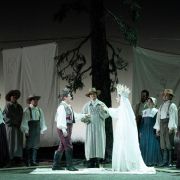
Livermore shifts the core of the conflict from religion and culture to time itself. The Greeks are portrayed traditionally in pepla with spears (costumes by Gianluca Falaschi), whereas the ‘Muslims’ appear as their modern descendants, wearing contemporary clothing, smoking, glued to their smartphones. The ‘siege’ becomes an assault by modernity, with its obsession over profit, surface appearance and individualism, against the classical heritage of Western culture, symbolised by archived architectural fragments. The sets (Eleonora Peronetti, Paolo Gep Cucco, Livermore) evoke a museum storage facility complete with restoration scaffolding and shipping crates containing classical statuary. Within the largest crate, video projections by D-Wok conjure a stylised vision of Classical beauty: flower-filled courtyards, an impossibly blue sea, and decadent, splendid palaces reminiscent of Lawrence Alma-Tadema paintings. As war breaks out, the visuals shift to fire, destruction and the crumbling remnants of a beauty the Greeks could not safeguard.


The concept is clear and effectively executed, although at times it leans too heavily into the pedagogical, such as when the invaders scatter trash bags across Corinth and snap selfies at inappropriate moments. The critique that contemporary society reduces classical antiquity and its values to shallow backdrops while desecrating them is incisive, yet the execution occasionally feels heavy-handed under an onslaught of visual cues. Overall, however, the visuals are striking, delivering a highly impactful and engaging theatrical experience.

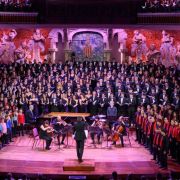
Conductor Carlo Rizzi delivered an intense reading of the score, emphasising its martial weight. The orchestra of the Teatro Comunale di Bologna produced a rich, powerful sound that maintained dramatic tension throughout, while highlighting the lyrical moments. The Coro Ventidio Basso offered an exceptionally polished performance marked by precise articulation and dynamic nuance.
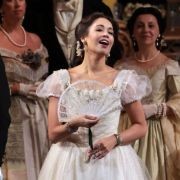
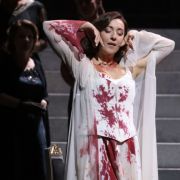
The standout of the evening was undoubtedly Vasilisa Berzhanskaya, who commanded the stage with her triumphant portrayal of Pamyra. Having transitioned from her origins as a mezzo, her voice now could be considered as firmly situated in soprano Falcon territory as she continues to expand into higher repertoire. Her coloratura was pearly and precise, her high register brilliant and steely, and her resonant middle voice anchored the score’s dramatic peaks. Her first aria “Du séjour de la lumière,” at the beginning of Act 2, completely changed the atmosphere of the opera, revealing its full tragic dimension. While she possesses all the makings of a great tragedienne, her delivery can occasionally still feel somewhat detached or overly clinical. Nevertheless, her lyrical singing proved deeply moving, featuring exquisite filati backed by flawless breath control. Her rendition of the prayer “Juste Ciel, ah!, ta clémence” was breathtaking.

Adrian Sâmpetrean’s Mahomet featured a smooth, well-projected bass, with good style. Although he acted with conviction, he lacked stage charisma, making it difficult to fully understand why a trailblazer like Berzhanskaya’s Pamyra would fall in love with him. Maxim Mironov delivered an outstanding performance as the Greek general Néoclès. Although the role was created for Adolphe Nourrit, who possessed a considerably more powerful and substantial voice, Mironov showed greater core warmth and presence in his middle register than in recent years, which, paired with his customary radiant top voice, flawless coloratura, and exemplary French diction, made for a convincing interpretation. His aria “Grand Dieu, faut-il qu'un people” was a definite highlight of the evening.


As Cléomène, Matteo Roma displayed a voice leaning toward the ‘baritenor’ spectrum; despite some occasional tightness on top, he turned in a persuasive performance. Simón Orfila’s Hieros was at times compromised by a wide vibrato, yet his commanding projection ensured an authoritative presence as the High Priest. Anna-Doris Capitelli brought a warm, bronzed tone to Ismene, while Giuseppe de Luca (Omar) and Tianxuefei Sun (Adraste, whose French diction needs refinement) rounded out a solid supporting cast.