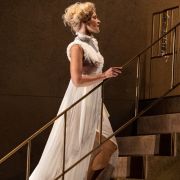
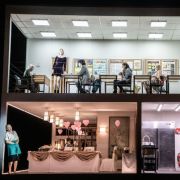
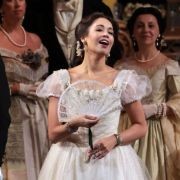
At 65, Romeo Castellucci, an Italian director with a distinguished career across Europe, finally stages an opera in his home country. Claude Debussy’s Pelléas et Mélisande, premiered in 1902, seems an ideal fit and he delivers a suggestive production at the Teatro alla Scala that perfectly captures the anti-rhetorical quality of Maurice Maeterlinck’s play (the source of the libretto) and Debussy’s score. From the opening scene, the stage is viewed through gauze that softens colours and shapes, as if seen through a light mist, reflecting an aesthetic close to Symbolism and Impressionism, the movements in which both Maeterlinck and Debussy evolved.

In the imaginary realm of Allemonde, time appears to obey its own laws: large stone high reliefs depict scenes from the story, as if events had already occurred and been memorialised. Other gigantic stones display fossil-like forms, suggesting origins in distant ages. Evocative video projections render forests, palace walls and the sea. Every object is suggested rather than shown: the fountain where the protagonists meet becomes a set of bowls of water, which Pelléas and Mélisande use as if baptising one another. The famous Act 3 scene, in which Mélisande lets down her extraordinarily long hair for Pelléas to caress and kiss, is represented by streams of white paint running down the black monolith of the tower, in which Pelléas sensuously wallows.


Castellucci demonstrates a virtuosic command of lighting effects, whereby the same elements, such as descending veils, appear to change texture and colour depending on the light. The stage is often dark and filled with shadows; the only truly bright moment comes when the two protagonists confess their love. Here, the light is almost blinding, the stage stripped bare, and the lovers appear in Pierrot costumes, as if in a childlike play, with stylised moons in the background.

The visuals are enchanting, perfectly conveying the dreamlike nature of Debussy’s score and the elusiveness of the plot. This is not an opera with a clearly defined narrative: many obscure events occur and characters speak without ever answering questions or offering explanations. Even the kinship relationships between them remain ambiguous. What emerges is that a prince, Golaud, encounters in a forest a mysterious girl, Mélisande, who has likely survived a violent sexual assault. Terrified, she refuses to answer questions. Golaud takes her to his castle and marries her within six months. They then travel to the castle of his grandfather, King Arkel, where his half-brother Pelléas lives. There, Golaud grows increasingly jealous of the bond between Pelléas and Mélisande, becoming violent until he kills his half-brother; Mélisande dies shortly after giving birth to a daughter.

This is accompanied by an almost complete absence of any conventional singing: the vocal style is a highly natural declamato, with little melodic line. Melody – and indeed narrative – reside primarily in the orchestra, which also contains echoes of Wagnerian leitmotifs, though far subtler than anything in Wagner. Everything is allusive and restrained. Maxime Pascal conducted the La Scala orchestra in a reading that aligned perfectly with Castellucci’s vision, shaping a continuous harmonic flow without emphasising strong dynamics or highlighting chromaticism. The music’s fluidity mirrors the constant presence of water on stage. Some may find the approach monotonous or lacking in ecstatic release; instead, under Pascal’s flowing direction, the orchestra breathed with quiet sensuality, shaping an interpretation that favoured atmosphere over drama. The result was a cohesive and persuasive performance, finely balanced and supported by an excellent cast.


Sara Blanch and Bernard Richter portrayed the two protagonists with fresh, youthful voices. Although Pelléas and Mélisande have also been performed by high baritones and mezzo-sopranos, both singers displayed an easy upper register that conveyed innocence and sensuality effortlessly. Blanch also revealed a dramatic edge, although her middle register was at times less projected than her radiant high notes. Richter’s natural emission and unforced top were particularly appealing.

Sir Simon Keenlyside brought experience to the role of Golaud, with a warm, smooth baritone and superb phrasing, alongside a commanding stage presence. Marie-Nicole Lemieux’s bronze-toned voice lent authority and nobility to Geneviève, while John Relyea, as Arkel, provided the required low notes, even if his bass occasionally lacked nuance and his diction could seem cumbersome. A final mention goes to Allegra Maifredi, from the children chorus of the Accademia at La Scala, who sang Yniold – Golaud’s son from his first marriage – with laser-like focus, impressive projection and flawless intonation.