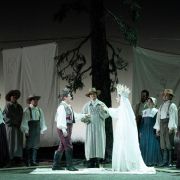
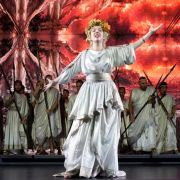
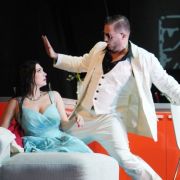
The third opera presented this year in Pesaro is another of the farces written by Rossini for the Teatro San Moisè in Venice: L’occasione fa il ladro, in a historical production by Jean-Pierre Ponnelle from 1987, lovingly revived by Sonja Frisell.

The plot is based on a contemporary French vaudeville: two traveling strangers meet at an inn where they are taking shelter from a storm, and they exchange their suitcases by mistake. One of them, Count Alberto, is traveling to Naples to marry a woman he has never seen; the other, Don Parmenione, is searching for a friend’s sister who has run away with a seducer. After the suitcases are swapped, Parmenione decides to usurp Count Alberto’s identity – using his passport and other papers found in his luggage – and heads to Naples to marry the girl himself. In Naples, as luck would have it, the prospective bride and the runaway are in the same house. As the prospective groom arrives, they decide to swap places to better judge his character. This leads to a series of misunderstandings, ending with an inevitable happy resolution and a double wedding.


Ponnelle’s production – his final stage work – is a masterclass in metatheatrics as well as a poignant artistic statement, an illustration of how to create art in service of opera through craftsmanship, imagination and respect. At the beginning, Martino, Parmenione’s servant, enters from the auditorium carrying a large suitcase; he hands a score to the conductor and walks onto an empty stage. From his suitcase, all the characters emerge and start reading their scores while stagehands build the sets on the open stage, raising beautifully painted backdrops, bringing in props, and helping the singers into their costumes. The precise and swift timing of the characters’ entrances and exits reflects Rossini’s structures in the pit, creating a light, effervescent show of pure theatre, unencumbered by the superfluous urge to ‘make the story relevant’. The opera is relevant because of its splendid score and the humanity of its characters, which emerges in all its poignancy through Ponnelle’s lightness of touch.

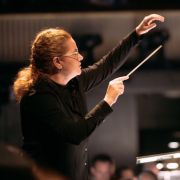
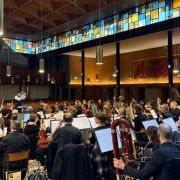
The opera does not have an overture, opening directly with a storm scene (which would later be recycled in Il barbiere di Siviglia). Conductor Alessandro Bonato immediately demonstrated an intimate understanding of Rossini’s idiom, leading the Orchestra Sinfonica G Rossini with a light hand, paired with intensity and drive. He avoided cheap effects, relying instead on colour and dramatic tension rather than sheer speed to do justice to the score. The overall impression was one of a serious, deeply prepared approach, audible in the meticulous care reserved for the recitatives – supported by the excellent Giulio Zappa (fortepiano) and Jacopo Muratori (cello) – and in the detailed variations, the true engine of the bel canto machine. The young conductor left the audience eager to hear him again in Pesaro and beyond.
A young cast brought fresh energy to the performance. As Conte Alberto, Dave Monaco shone with a commanding interpretation, his voice perfectly suited to the tenore di grazia repertoire while also displaying power and vigor. His high register was brilliant and his coloratura truly exciting, as demonstrated in his aria “D’ogni più sacro impegno”.


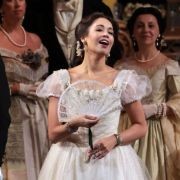
As the bride, Berenice, Damiana Mizzi gave a very good rendition of her first lyrical aria, “Vicino è il momento”, displaying fine legato and an elegant touch. Her light soprano was pleasant and agile, particularly in “Voi la sposa pretendete”, her coloratura fast and precise. While her top notes were occasionally somewhat pinched – super-high notes were not entirely successful – her interpretation was overall fitting for the character, if a bit lacking in spirit and vivacity.
Parmenione was played by Matteo Mancini, a young baritone native to Pesaro with a mellow, well-supported voice and a strong grasp of the musical style. He did not seem to have fully mastered the buffo acting style yet, though this may simply be a matter of youth and experience: his voice projects well and possesses a lovely timbre, giving him plenty of time to refine his craft.

As the seconda donna, Ernestina, Martiniana Antoine lacked a bit of vocal projection, but her technique was flawless, marked by great precision and a beautiful tone colour. Martino is another buffo baritone role – a sort of heir to Leporello and precursor to Figaro (Barbiere). Giuseppe Toia, another young baritone, showcased a beautiful voice with a dark timbre and strong commitment to the role, though he too will likely need more time and study to fully master buffo performance. Manuel Amati sang the small role of Don Eusebio, Berenice’s guardian, with a clear, pleasant high tenor, visibly enjoying the character and his eccentricities.