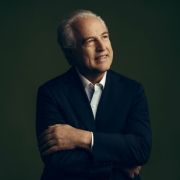
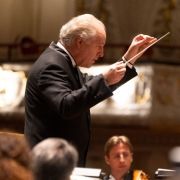
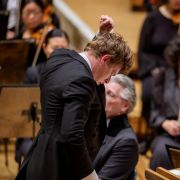
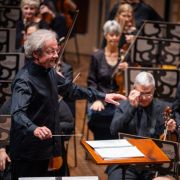
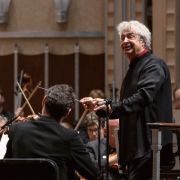
Friday night’s Pittsburgh Symphony concert fell right on the heels of some major news for the organization. Manfred Honeck’s contract as Music Director has been extended through the 2032-33 season in what will become a 25-year tenure, the longest in the orchestra’s 131-year history. Devoted to America250, the final two weeks of the current season are fittingly celebratory in spirit, showing the wide stylistic breadth of American orchestral music.

Friday’s program was a particularly eclectic grab bag of Americana, opening with a work written for the Pittsburgh Symphony. Joan Tower’s Tambor was commissioned by then-Music Director Mariss Jansons, premiered in 1998. The Spanish word for “drum”, Tambor draws inspiration from the music of South America, where the composer spent much of her childhood. With bracing beginnings, the work flooded the hall with strident brass and thundering percussion. The extensive array of percussion was indefatigable across the piece’s 15-minute duration, building with vigor to a foot-tapping groove. Though an energetic opener, I was left to wonder if it could have said what it wanted to in about half the length.


Another major living composer was explored next in John Adams. The Wound-Dresser dates from 1988 and is scored for baritone soloist with orchestra. The work poignantly sets poetry by Walt Whitman that speaks to the poet’s haunting experiences of treating wounded soldiers during the Civil War. Wispy strands of strings began, as if barely hanging on to life. Solo passages from concertmaster David McCarroll pushed high into the violin’s upper register, and an offstage solo trumpet amplified the atmosphere of loneliness and resignation. Quietly reflective, The Wound-Dresser shows a different side of Adams than the hypnotic minimalism in which he is more readily identified.

Matthias Goerne brought depth and feeling, but perhaps there was latitude to be even more heart-wrenching to better match the text. In an addition to the originally announced program, Honeck made a distinctive interpretive decision by following the Adams piece without pause with “Ich habe genug” from Bach’s Cantata no. 82. Though both works concern a confrontation with death, it was a bit of a jarring transition, but I found Goerne deeply sincere and convincing here, supported by the gently flowing oboe solo of Max Blair and the PSO’s pellucid playing.
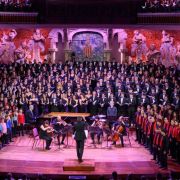
Bernstein’s Chichester Psalms was the highlight of the evening. Sharp, angular gestures began, made all the more captivating by its colorful orchestration. Under the direction of Daniel Singer, the Mendelssohn Choir of Pittsburgh sang in rousing fashion, giving character and interpretive force to the Hebrew texts (a notable choice on the composer’s part, given this was a commission for the Anglican Church). Solo passages from various chorus members afforded more intimate moments.


The central setting of Psalm 23 spotlighted 11-year-old boy soprano Hudson Schmitt who offered a voice of angelic innocence, before the peace was broken by the chorus in a stark setting of “Why do the nations rage”. An impassioned, despairing string chorale opened the final section before the pensive chorus joined, furthering this strong showing from the Mendelssohns.

Painted in broad strokes and with a fervent optimism, Copland’s Lincoln Portrait may well be described as quintessential Americana. Tunes by Stephen Foster (who was born Pittsburgh) were woven into Copland’s vibrant American fabric. The role for speaker was given by F. Murray Abraham, familiar to music lovers for Oscar-winning portrayal of Antonio Salieri in Amadeus. Abraham is also a Pittsburgh native, and graciously donated his time for the weekend’s performances. His dramatic oration and resonant voice lent dignity and gravitas to Copland’s enduring portrait of the former president.