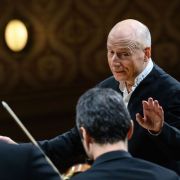
According to Cleveland Orchestra Music Director Franz Welser-Möst, there are basically two ways to program a concert: as a “cohesive throughline” that tells a story, or as a study in “bold contrasts.” A pairing of Mozart and Shostakovich offered a hefty dose of the latter, though perhaps not quite in the way the conductor expected.

The first half of the concert was devoted entirely to Mozart’s Jupiter Symphony, arguably the composer’s finest symphonic work. The blend of technical sophistication and emotional appeal is unparalleled, but neither came to the fore in Welser-Möst’s lackluster treatment of the piece. It lacked authority, energy and substance, relying mostly on a lyrical quality in the playing and strong dynamics reflecting the conductor’s penchant for contrasts. Overall the sound was flabby rather than crisp, and at times strained, reaching for peaks it never quite reached.


Welser-Möst’s strength is the classic golden Viennese sound, which with the Cleveland Orchestra’s sumptuous violins is not difficult to achieve. The woodwinds also shone in this performance, particularly in the middle two movements, adding intricate dashes of color. A measured tempo gave both sections room to breathe, though it wasn’t until the finale that the music picked up momentum and a steady flow. Properly done, this is a thrilling piece that should get one’s blood racing. But in that respect this performance was anemic, more a reminder of what the symphony could be rather than a realization of its full potential.
After intermission, a pleasant surprise: a finely detailed, expertly crafted rendition of Shostakovich’s Symphony no. 11 in G minor, “The Year 1905”. Building on a deep bottom that was missing in the first half of the concert, Welser-Möst created a powerful sense of foreboding in the first movement that erupted fiercely into the violent clashes of the second movement, then maintained a pulse that powered the melodies in successive movements. Throughout even the most tumultuous passages, there was superb clarity and balance in the sound, and in the quiet moments between the outbursts on Palace Square, an undercurrent of apprehension that the conductor sustained throughout.
Virtuoso work by individual sections of the orchestra made significant contributions. Percussion is not often described as atmospheric, but in this case sharp execution on the timpani and snare drums was like a narrative in itself, relentlessly ticking and marching to a horrific fate. The clarion sounds of the brass were also richly expressive, in particular the repeated trumpet call that started out plaintive and quickly turned alarming. The woodwinds once again stood out for their color and verve, and the viola work in the funeral march of the third movement was skillfully calibrated, setting just the right somber tone.


Overall, one might have wished for more emotional impact. In some ways the piece seemed two-dimensional, a painting created with both precision and breadth, though not much depth. But as an invocation of a specific time and place it was brilliant, leaving listeners room to bring their own feelings and reactions to a searing re-creation of a historic tragedy.
As for contrasts, Welser-Möst was much more effective invoking them within the individual pieces than in juxtaposition. Maybe next time, give the cohesive throughline a try.