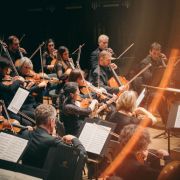
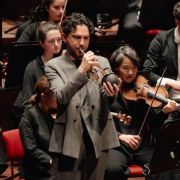
Dutch recorder virtuoso Lucie Horsch is a force of nature. In her latest project with Ghent-based B’Rock Orchestra, led and directed by the hugely talented Evgeny Sviridov, we view Baroque music through a new and very modern lens. Context is all. Prefacing well-known Corelli and Vivaldi concertos against arrangements of Bartók and Kurtág’s piano music, plus a technically challenging commission from Dutch composer Rob Zuidam, certainly added an element of excitement to their performance in the Concertgebouw’s Klein Zaal. For a young lady who relishes a challenge, sleepwalking through a night filled with ghost and ghouls was programming genius.

A particularly evocative Largo in Vivaldi’s Concerto in G ‘La notte’ set the tone. Calm sustained chords cushioned Horsch’s opaque tranquility while the lute’s delicate dance gave little indication of the fury to ensue. Horsch’s dynamic range defied belief, all made possible by cheeky alternate fingerings so as not to alter the pitch.


Kurtág’s …A Sappho Fragment… from Signs, Games and Messages found the recorder’s haunting strains echoing deep in a forest and provided a surprising segue into Corelli’s Christmas Concerto Op. 6 no. 8. Turning to her sopranino, Horsch’s fluttering ornaments, usually heard on the violin and perfectly complemented by the harpsichord’s florid and improvisatory flourishes, felt surprisingly playful and free. Returning again to the forest, Kurtág’s In memoriam Aczél Gyorgy found voice in the solo viola’s searching tones as microtonal glissandos added a very novel context for the Vivaldi to come.
Revisiting a work which helped launch her career ten years ago (and not performed since) must have stirred memories, but after a quick clean of her recorder, the dramatic second movement of Vivaldi’s Concerto in C minor came as a pleasant surprise. Through this new lens, Horsch’s technical proficiency with just three string players for company was inspirational and greeted with the warmest applause.
The partnership between viola and recorder continued in the Dutch premiere of Rob Zuidam’s Airs, Riff and Runs. Four-note riffs passed around, before the B’Rock Orchestra’s world of gothic druids and mysterious menace, full of ethereal and metallic harmonics, created a vivid sound canvas for the recorder’s wild meanderings. Horsch’s low notes rose high in the sky, fluttering, swirling or simply cascading. This was Baroque recorder, just not as we traditionally know it. Bending the pitch, this time by resting the recorder on her knee, she quickly replaced soprano with sopranino before flutter-tongue, trilled chords burst forth. A cheeky cello glissando to conclude made this an audience favourite. Zuidam’s hugely accessible and explicit storytelling, a film score in all but name, and performed exquisitely without a conductor, will find life for many years to come.


Like Kurtág’s earlier meanderings, Bartók’s Wandering and especially the Notturno's lonesome arpeggiated cello chords, returned us to a Hungarian woodland and was the perfect introduction to Vivaldi’s very own icy ‘Winter’ world, his Concerto in F minor. A ferocious tempo saw Horsch’s own arrangement of Vivaldi’s violin concerto through a very modern lens. Perhaps the odd low note may have struggled to cut through, but the Largo’s very high, undulating calm left worries behind. The finale’s empty landscape pushed each recorder to its limit. Her encore, Bartók’s The Chase, left none in doubt about this exciting partnership between Belgium’s innovative period and contemporary music ensemble and Amsterdam’s very own recorder wonder.