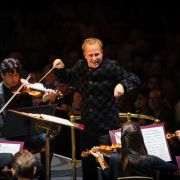
Michael Tilson Thomas, who died in April this year, was an important and much beloved figure for the London Symphony Orchestra, who dedicated last night’s concert to him, with many eulogies both in the programme booklet and delivered on stage before the concert. The LSO memories of MTT as a champion of Mahler are particularly strong, which is presumably why they chose this particular concert, Mahler’s Fifth Symphony conducted by Sir Antonio Pappano, as the one to be dedicated to MTT’s memory.

The first movement made an immediate impact, exactly the celebration of Mahler we might have hoped for. The sheer quality of playing shone through from every section of the orchestra, starting with the haunting opening trumpet call, continuing with the full orchestra’s percussive, explosive entry and on towards the steady tread of the funeral march, pregnant with nostalgia as the melodies soared and swooped above it. The string sound was sumptuous, the brass portentous, the woodwind interjections full of character, the flute particularly delicious in the contrasting themes, the musicians fully attentive to the emotion issuing forth from their batonless Chief Conductor.


The excellence of orchestral timbre and Pappano’s commitment to the music remained undimmed through the remaining movements, but this symphony needs more than superb sound and a charismatic conductor. Like all Mahler symphonies, it is architected on such a massive scale, with the music going through so many highways and byways, that it demands that the listener be given a clear sense of progression towards an end. Every conductor has their own approach to this, but on this occasion, some minutes into the frantic second movement, I realised that I was starting to lose the thread. While each individual motif was beautifully played and made complete sense on its own, I had no feeling of being gripped and marched to an inevitable conclusion.
The pattern continued in the third movement scherzo, with delicious sleigh bells, perfectly weighted strings and cheeky clarinet or flute motifs – but just a few instrumental slips and uncertainties creeping in. The fourth movement Adagietto was disappointing in just one respect, but an important one: the harp was too quiet compared to those gorgeous strings to lend the movement its full shape. The finale was a suitable romp.
Mahler’s Fifth is one of the great symphonies and listening to it performed live by an orchestra of the LSO’s calibre is always a joy. But this won’t go down as the best Mahler I’ve ever heard.
Before the interval, we were in a different, more pastoral sound world, with a creditable rendition of Elgar’s Enigma Variations and making the most of the score’s big moments: the delicate romanticism of “CAE”, the gentle humour of “RBT”, a perfectly calibrated swell for “Nimrod” and a bit of contrasting bombast for the closing “EDU”. But I generally find it problematic when an hour or more of Mahler of Bruckner symphony is preceded by an interval and a far less substantial work, and I’m sorry to say that Pappano and the LSO failed to persuade me that this was the exception to prove the rule. Although both composers were the same age (41 years old) when they started to write these two works, Elgar was at a far earlier stage in terms of reaching fame as a composer, and although the Enigma Variations contain wonderful moments, they don’t approach Mahler 5 as a serious, consequential work.