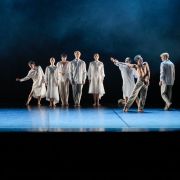
As the audience enters the Salle des Princes at the Grimaldi Forum, the curtain is already open on a stage occupied by grey structures, later revealed to be the reverse side of the Act 2 set. Spectators are immediately drawn into the daily life of the dancers, who walk onto the stage and warm up in full view. In this way, Jean-Christophe Maillot, who has led Les Ballets de Monte-Carlo for more than three decades, introduces a world première marking his personal appropriation of La Bayadère, aptly entitled Ma Bayadère.

Originally created by Marius Petipa to music by Ludwig Minkus for the Imperial Ballet in Saint Petersburg in 1877, La Bayadère stands as one of the cornerstones of the classical repertoire. What, then, can it still tell us today? Maillot responds by transforming the work into a portrait of the inner dynamics of a ballet company, reshaping it as a work that reflects upon dance itself.
At a time when the dance world is increasingly drawn to transparency, through initiatives such as World Ballet Day, open classes and the growing exposure of dancers’ lives, this production embraces the same impulse and elevates it into art. By bringing the backstage onto the stage and exposing even what we might wish did not exist, including rivalries and jealousies, it blurs the boundary between reality and fiction, ultimately transcending both.


The original plot of La Bayadère follows the temple dancer Nikiya and the warrior Solor, whose love is thwarted by the High Brahmin’s jealousy and by the Rajah’s command that Solor marry his daughter, Gamzatti. After Nikiya is murdered by a poisoned bouquet at the betrothal, a grief stricken and opium dazed Solor enters the Kingdom of the Shades in search of her spirit.
Maillot reimagines this web of intrigue within the inner life of the troupe. The characters evoke their classical counterparts and are chromatically defined: Niki, a young dancer and the dramatic centre of gravity, a kind of designated victim, appears in a white tunic (Juliette Klein); Gamza, her antagonist, a danseuse étoile in a red tutu (Romina Contreras); Brahma, the maître de ballet, in green (Michele Esposito); Rajah, the choreographer, dressed in black (Jaat Benoot); Solo, a danseur étoile in white (Ige Cornelis), loved by both Niki and Gamza, is accompanied by his friend Magda (Francesco Resch).

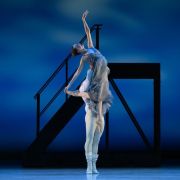
References to La Bayadère are finely woven throughout the ballet, along with the sense of the sacred that permeates the original work, here reconfigured as a daily ritual of discipline and devotion to the art. All the key moments, such as the Pas des écharpes and the Parrot Dance, are absorbed into a backstage setting, becoming occasions for collective displays of virtuosity in the service of Rajah, the demanding choreographer. Nikiya’s death is transformed into Niki’s suicide, as she climbs a stage structure and throws herself behind it, a finely crafted illusion that leaves the audience holding its breath.

Despite the death, the show must go on, and a miniature stage descends from above, where a “real” Bayadère unfolds, complete with the Golden Idol (Alexandre Joaquim), a “real” Nikiya (Ashley Krauhaus), and other key figures who enter and exit through this small theatrical portal. As the company’s drama is gradually absorbed into that of La Bayadère, Solor is left alone on stage, devastated by the loss of Niki.


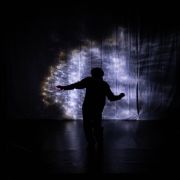
The second act opens in fog, encircling an abstract evocation of the Himalayan peaks, a reminder of the original Indian setting. The protagonists reappear in softened versions of their colours, like apparitions, as passions are gradually diluted. Particularly effective is the reimagining of the entrance of the shadows. The corps de ballet enters one by one, as if carried forward by a moving walkway, their upper bodies gliding along the outlines of the mountains. Niki is present too, passions dissolved into a more tender and collaborative atmosphere, marked by physical intimacy among the protagonists. The ballet concludes beneath a rain of shimmering silver confetti.

Maillot reshapes both the ballet and its score, allowing the most inspired musical moments to emerge with renewed clarity. His choreography is elegant, precise, engaging and occasionally unexpected, marked by moments of bold expressivity. The idea of the meta ballet is captivating, yet the accumulation of levels, frames, and narrative shifts can at times feel overly elaborate and difficult to grasp, with multiple lines unfolding on stage simultaneously.
The dancers bring this vision to life with remarkable commitment. Splendid and impeccable, endowed with striking virtuosity, the corps de ballet functions both as choir and living scenography, accompanying and sustaining the protagonists in Act 1 and Act 2 beautifully encircling the action like petals of a flower. One is nonetheless left looking forward to seeing how much more these extraordinary performers might shine within a more traditional ballet framework, one in which dance itself, rather than the act of narrating dance, remains at the centre.
Elsa's trip was funded by Les Ballets de Monte-Carlo