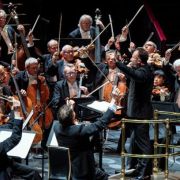
The Brighton Philharmonic Orchestra made a well-deserved return to the Brighton Festival this weekend. But despite recent great strides in adventurous programming and standards made under Joanna MacGregor’s artistic direction, could they rise to the challenge of Shostakovich’s mighty Tenth Symphony? Happily, yes they could, with some of the best playing I have ever heard from them.

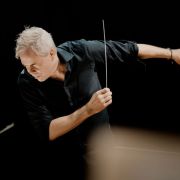
Their performance was accompanied by William Kentridge’s fascinating and absorbing film, Oh to Believe in Another World, commissioned by the Lucerne Symphony Orchestra in 2022. In his on-stage introduction and programme notes Kentridge talked about the danger of such a film turning the symphony into background film music, or alternatively, the film providing “anodyne backdrops” with the main attention on the music. Largely, his film avoids both, although inevitably from time to time one’s attention focusses on the film at the expense of the music, and vice versa. The BPO’s performance was strong throughout, if not the most searing of renditions. In a way, slight restraint helped their playing not overshadow the film. Having recently seen Vasily Petrenko driving the Royal Philharmonic through a violent and downright scary Scherzo, MacGregor’s take was less wild, their skittering race fitting well with Kentridge’s ironic imagery on film of bustling transport and crowds, later skewering the idea of relentless progress with shots of the realities of harsh manual labour.


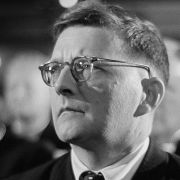
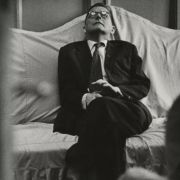
Kentridge’s ‘set’ is a miniature cardboard Soviet museum, complete with a concert hall and run-down public swimming pool. Hands occasionally stray into the set, and we see glimpses of his studio table, which all serve to show the scale of this miniature world. This is then punctured by his superimposed animation of live dancers and actors, with masks to portray specific characters in the drama (Lenin, Trotsky, the poet Mayakovsky and his lover Lily, Stalin, and Shostakovich himself). Again, we occasionally see ‘slips’, showing the faces and limbs of the dancers, and their dancing is animated to accentuate their jerky, contorted movements, combining comic quirkiness with a disturbing constriction, the fixed gazes of their masks staring out at us.
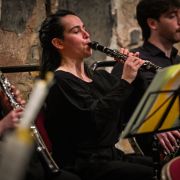
In the first movement we see Shostakovich conducting clumsily with Mayakovsky and Lily in a weirdly hypnotic dance. MacGregor and the BPO responded here with their own queasy dance from the clarinets, followed by plaintive strings. The third movement attempts to unify Shostakovich’s personal D-S-C-H motto with a motto for Elmira Nazirova (both formed from coded use of letter names for musical notes). Elmira was a younger pupil with whom he became infatuated; the film had her dancing eerily, later with Shostakovich at her side, with more than a hint of creepiness – she was by all accounts less interested in his advances. Principal Horn Alexei Watkins delivered Elmira’s motif with secure warmth, while the flutes and piccolos screamed the D-S-C-H motto.
In the finale, the façade falls and Kentridge shows the actors’ faces behind the masks, with Mayakovsky and Lily swapping heads in their macabre dance. The clarinets successfully launched the faster tempo that led to Shostakovich’s typically ambiguous conclusion – a defiant celebration of triumph and the death of Stalin? Hard to be sure. From the orchestra, we had a wonderfully acerbic solo from bassoonist Jonathan Price, and the brass hammering out that D-S-C-H motto at the conclusion certainly cried out defiance. In the film, Shostakovich has arrived at the top of the diving board, where earlier we saw Lenin and Stalin. So did he ‘win’ in the end? Neither the film nor the music gave us a clear answer, but the combined effect was nevertheless emphatically powerful.