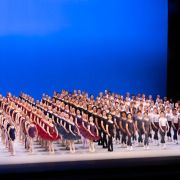
As far as I am aware the students of the famed School of American Ballet haven’t performed in London before, so it was with much anticipation that their joint performance with the graduating students of the Royal Ballet School was awaited. In many ways the two types of training could not be more different: the RBS, with its attention to detail and precision, and SAB with it’s Balanchinian openness and brilliant speed work, have styles that reflect their separate histories and cultures. There is so much to admire in both styles that I knew we would be in for a feast of an evening, and thus it proved.

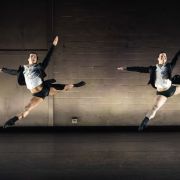
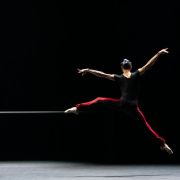
The young dancers of the RBS had themselves curated their section of the evening, and there were some surprisingly ambitious choices from the established repertoire, as well as opportunities to showcase choreography by the students. These included Eccentric Pulses, choreographed by RBS alumnus Guillem Cabrera Espinach, now a member of the Joffrey Ballet in Chicago. While at the school, he won a choreographic prize and his work here showed definite promise. The piece was very well danced by Elliott Martin and Shiori Yamashita, coached by company rising star Caspar Lench.


Suffocating in Silence by Pre-professional year student Henry Burgess was also of interest, particularly as it was danced by the intriguing Samantha Striplin, a performer of charismatic power and dynamism as well as strong technique. I’ll be keeping my eye on her progress.

Two luminaries of the 2023 Prix de Lausanne, Fabrizzio Ullua Cornejo and Millán de Benito Arancón, each danced a solo, Cornejo choosing Calvin Richardson’s version of The Dying Swan, and Arancón, Ben Van Cauwenbergh’s witty Les Bourgeois. Although this is a rather sophisticated choice for a youngster (the more inebriated the performer appears to be the funnier it is) Arancón’s cheeky chappie interpretation was extremely charming and he’s a beautifully elegant dancer. I was delighted to see how his already impressive technique has developed since he won his Prix prize. Cornejo is a highly accomplished technician and served Richardson’s sinuous movement well.
Christopher Wheeldon’s Christening Suite showcases his classicism interspersed with quirkiness with which the dancers will, I am sure, become well-acquainted during their professional careers. All concerned danced superbly, with Arancón and Sophia Koo impressive in the leads.

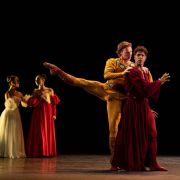
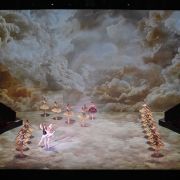
I was delighted to see that the students had chosen Anna Meadmore’s excellent reconstruction of the early de Valois ballet The Arts of the Theatre. Meadmore, a supremely valuable asset to the school and the ballet world generally, discovered Ursula Moreton’s detailed notes made during the ballet’s creation in 1924, and conjured the whole from the fragments. Danced to Ravel’s La Valse (and here I can only gasp in awe at the pianistic skills of The Royal Ballet pianist Kate Shipway) it is a work of great charm, with five girls depicting the titular arts with individualism and character, beautifully coached by Meadmore herself.
Another 2023 Prix finalist, Wendel Vieira Dos Santos, was the best of the four young men in the quartet from Raymonda, which perhaps needed a little polishing. The pas de deux from Rhapsody, not an easy piece choreographically, was danced with style by Azusa Tanaka and Dylan Weinstein.


SAB gave us a gorgeous account of Balanchine’s lung-busting Valse Fantaisie, infrequently seen in the UK. Four very Balanchinian ladies danced in perfect unison, whilst using their individual charm to draw us in to their work. The joyous openness of American upper backs and ports de bras were gratifyingly in evidence, and lead couple Jaiya Chandra and Samuel Greene coped well overall with the demands of the partnering work.
What is not to love about Who Cares? Balanchine’s great Gershwin ballet is a terrific audience-pleaser and so it proved again here, with the young dancers living up well to my memories of some very illustrious NYCB casts. Renee Augustyn, Simone Gibson and Ador Kadiasi are all ones to watch.

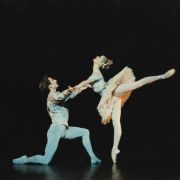
I have left the best until last: a truly astounding account of the balcony pas de deux from MacMillan’s Romeo and Juliet from the RBS. You do see what I mean about ambitious, right? This usually never works for me out of context, and at first I thought it would be the same again as there was some hesitancy in the beginning, but very soon I was wondering how on earth such young dancers could give such a mature, stylistically accurate and moving performance, with never a technical slip.

Alecsia Maria Lazarescu and Ivan Malaguti are both, I say with confidence, future stars and I particular commend them (especially Malaguti) for their near-flawless double work. They were applauded rapturously by the audience, and I heard several of my neighbours whispering to their companions that they had been close to tears. My immediate neighbour described it as a “you saw them here first” moment, and she is right. We’ll be talking about this for years to come.