Curating a triple bill that brings two brand new works by relatively unknown choreographers to follow that of an acknowledged master of the trade is a risk, so kudos to English National Ballet’s artistic director, Aaron S. Watkin for commissioning this gloriously challenging and diverse programme.

The collaboration of George Balanchine and Igor Stravinsky created twenty ballets between Apollon Musagète (1928) and the two classics produced by Balanchine for the Stravinsky Festival, a year after the composer’s death, one of which was Symphony in Three Movements (1972). Their association must have a claim to be one of the greatest artistic partnerships of the twentieth century.
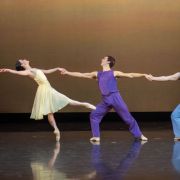
Symphony in Three Movements is a veritable hurricane of a ballet with torrent after torrent of movement and patterns in its 21 minutes that require virtually the whole company to perform, in the late Balanchine trademark of rehearsal leotards and tights.


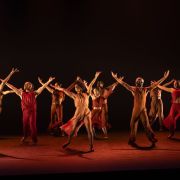
Balanchine loved to grab his audience’s attention with a curtain-raising spectacle and here it is in the sight of sixteen women perfectly framed by a deep blue backdrop in a diagonal line. It’s a rare moment of stillness in a ballet that reflects the score’s dynamic opening and closing movements with relentless motion. The choreography is so fast-paced and challenging that it was a risk to attempt it, but, barring some very minor moments of disunity, the whole company rose to the challenge with aplomb.
Three principal couples are supported by five demi-soloist pairs, and these sixteen front-rank dancers are backed by a large corps that weaves intricate patterns on the bare stage. It was a great pleasure to welcome Ksenia Ovsyanick back to the company she left ten years ago and her middle duet with Rentaro Nakaaki was a reminder of the imperious artistry that we have missed over these intervening years.

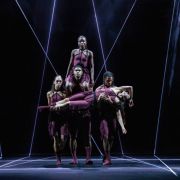
Micaela Taylor’s Bow Out continued an ENB tradition that began before Watkin. Inspired by the work of the legendary Nicholas Brothers, it is of the same hi-energy, jazzy quality as Stina Quagebeur’s Take Five Blues and Bill Forsythe’s Playlist series and the company has consistently proven its enjoyment of these powerhouses of rhythm; a joy that palpably transfers to the audience.
The Lindy Hop and faux-tap sequences were exceptional, and it was a pleasure to see accomplished classical ballet dancers such as Aitor Arrieta step out of their comfort zone to excel in different genres. Taylor is a fast-rising young choreographer capable of crossing boundaries from hip-hop and commercial to classical ballet and I expect to see much more of her work in the repertoire of major companies in years to come.

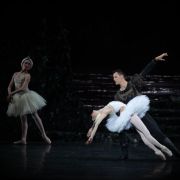
Bow Out would have been an uplifting end to the programme but in another piece of successful risk-taking, Watkin altered the order just a fortnight before this premiere and New York-based Korean choreographer, Jae Man Joo, had a lot to live up to in the final work, Auguries of Innocence. His inspiration was William Blake’s eponymous poem, published in 1863, and the work opened with a spectacular image, to match that of Balanchine’s curtain-raiser, with Sanguen Lee – as The Weaver of Souls – in an Amazonian pose on the darkened stage. Her spiritual presence in a black dress with a long train was an important leitmotif.


The opening movements of a work contrasting good and evil had a strong gothic feel which relaxed slightly over three scenes, concluding with a coruscating pas de deux for Ovsyanick, long hair flailing, and Daniel McCormick, full of sensuality, emotion and powerful lifts, followed by another elegant, anguished duet for Emma Hawes and Gareth Haw. Lee, Haw and now Ovsyanick have been tremendous acquisitions under Watkin’s reign.

While there was much to marvel at onstage, the orchestral challenge was just as remarkable with the ENB Philharmonic, conducted by Maria Seletskaja, tackling three intense scores, as different as they could be, from the intellectual liveliness of Stravinsky, through Tru’s Heard Infinitely composition for Bow Out, featuring impactful Fosse-style voiceovers and a sampling of Summer Stock’s Get Happy sung by Samantha Beltran (but if I hadn’t read that I would have believed it to be by Judy Garland since the vocal similarity was unmistakeable). And then finally, Seletskaja got to conduct the music of Pēteris Vasks in his Musica Dolorosa and Musica Serena: conductor and composer have a strong Baltic connection, Seletskaja is from Estonia and Vasks is Latvian.

This was a significant test for the company, particularly after the mixed reception to its previous double bill, Body and Soul, and the whole team from director to newest corps recruit rose superbly to the challenge. Virtually the whole company populated the Balanchine and then split into two halves for the following works, which were created in splendid isolation from one another, but joined together in quality and contrast like matching pieces of a jigsaw.