Il viaggio a Reims was the first opera that Gioachino Rossini wrote for Paris, conceived as a ceremonial work to celebrate the coronation of King Charles X of France in 1825. The plot is exceedingly flimsy: a group of distinguished European guests are attempting to reach Reims to attend the coronation but find themselves stranded at the spa resort Il Giglio d’Oro because they cannot procure horses for their carriages. This predicament becomes a pretext for celebrating the guests’ various nationalities, quirks, idiosyncrasies and romantic entanglements. Throughout, Rossini gently mocks the characters and the triviality of their concerns, portraying them as vain, superficial and often ridiculous.

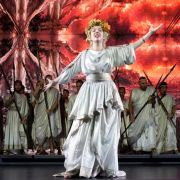
In this new production at the Salzburg Whitsun Festival, Cecilia Bartoli and director Barrie Kosky have reimagined this brilliant comedy to celebrate her own milestone birthday, which falls in just a few days. The libretto was adapted accordingly, with the guests speaking of “La Ceci” instead of “Re Carlo”. Rather than celebrating France, the production becomes a celebration of music as a unifying force, the text duly modified to reflect this concept. At the end, La Ceci, disappointed the guests could not attend her birthday party, sends them an enormous birthday cake as consolation. Inevitably, she emerges from the cake as herself.


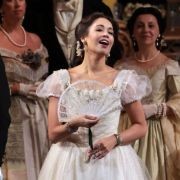
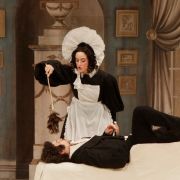
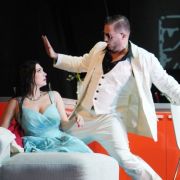
Kosky approaches the work by emphasising the opera’s irony and its satire of the characters, who are presented in extravagant, colourful costumes by Victoria Behr, complete with exaggerated hairstyles and an endless array of nervous tics. Kosky appears afflicted by a severe case of horror vacui, driving the entire cast into a state of perpetual frenzy. The performers are constantly jumping, screaming, squealing, giggling, sneezing, hiccupping, fainting, tripping over one another and—above all—rushing through doors and slamming them. Every solo is accompanied by a barrage of comments, rhythmic interruptions, exclamations and reactions from the surrounding cast. Noise is constant, loud and relentless. Kosky also introduces a pronounced sexual element, most notably in a nighttime scene where twelve hotel doors open and close with singers and mimes dashing from room to room in varying states of undress, suggesting a web of increasingly improbable romantic encounters.

Yet Rossini’s exuberance does not require frenzied stage direction. His chaos is organised. It possesses structure and the music itself is more than capable of generating a sense of whirlwind energy and feverish excitement. One artist who clearly understands this is Gianluca Capuano. Leading Les Musiciens du Prince, he once again demonstrated his profound affinity with Rossini’s style, drawing from the orchestra a remarkably transparent sound marked by rhythmic vitality and sparkling brilliance. The period instruments offered a rich yet clear colour palette, bringing Rossini’s melodic invention vividly to the fore while simultaneously revealing the precision in the construction of the score. Capuano also chose to include several of the ballet numbers composed for the opera, rarely performed, which provided a welcome bonus.

The cast brought together some of the finest Rossinian singers of today. First and foremost was Bartoli herself who, as the poetess Corinna, ultimately portrayed a version of herself with considerable self-irony. Her voice appeared in splendid condition: the upper register was brilliant and smooth, her phrasing displayed exceptional musical intelligence and her pianissimi were exquisite. In her duet with the Cavalier Belfiore, sung by tenor Edgardo Rocha, both displayed excellent comic timing, vocal precision and sparkling chemistry.


Mélissa Petit, as the Contessa di Folleville, sang with a bright, gleaming soprano and dazzling coloratura while revealing a comic flair I had not previously encountered in her performances. The Marchesa Melibea was conceived as a femme fatale, and Marina Viotti was superb, her deep, bronzed mezzo-soprano velvety and seductive. Her duet with Conte di Libenskof is one of the finest numbers in the opera, and Viotti and Dmitry Korchak delivered it with equal measures of humour and emotional depth. Korchak successfully navigated the formidable demands of the role, including its punishingly high tessitura.

As Madama Cortese, the hotel’s hostess, mezzo Tara Erraught demonstrated remarkable versatility, singing with a light, silvery tone, agile coloratura and strong stage presence. Misha Kiria was irresistible as Baron Trombonok, a German aristocrat here portrayed as a reincarnation of Wilhelm I of Prussia. His powerful bass anchored proceedings as he desperately attempted to impose order on the surrounding chaos. Florian Sempey, as Don Profondo, delivered the famous aria “Medaglie incomparabili” with spectacular sillabato technique while dressed in BDSM gear (don’t ask). Ildebrando D’Arcangelo brought his customary style and authority to Lord Sidney.

The great concertato a quattordici voci was the undisputed highlight of the evening. The cast sang with remarkable precision and genuine delight, while Capuano somehow managed to keep singers and orchestra perfectly together at a breakneck pace – a truly Rossinian feat.