According to François Couperin writing in 1725, the perfection of music arose from the union of the French and Italian styles. It might be suggested that this perfection was set in train by Luigi Rossi’s Orfeo. The Italian composer was summoned to Paris in 1646 by Cardinal Mazarin, and the following year Orfeo was premiered at the Théâtre du Palais-Royal, one of the first operas to be seen in France, some 40 years after Monteverdi’s Orfeo was performed in Mantua, Italy.

Far from being just an historical record, Orfeo was most enjoyably brought to life by the French ensemble Pygmalion, who now own the 17th century as far as Adelaide goes, with their previous concerts at this year’s festival. Done without scenery or props – for which there is little room at the Adelaide Town Hall – the opera was nonetheless suitably dramatic, helped by an excellent cast. Most people would have some idea of the story, although the presence of several deities involved in by-play may have been somewhat obscure.


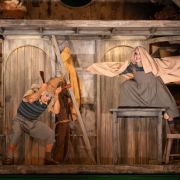
The narrative was considerably streamlined here. The original version runs for some 3.5 hours, whereas this performance came in at 2 hours 20. The political prologue was jettisoned altogether, as was the final scene after Orfeo’s peroration. A number of deities got the chop, and some of those remaining had their roles abbreviated. Even so, there were 15 named solo parts to be filled, not to mention Graces and Fates, with some doubling of roles. Countertenor William Shelton, for instance, played both Euridice’s nurse, wearing a black lace headscarf along with a white shirt and pink trousers, and Amore, where he swapped his scarf for a matching pink jacket.
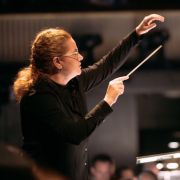
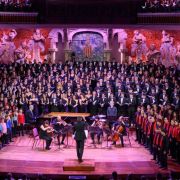
The orchestra under Raphaël Pichon was pretty much as for the Monteverdi Vespers, albeit with fewer sackbuts. They played with grace and finesse, never overwhelming the singers. The choir played a dynamic role, deployed in different sized groups and sometimes singing from the gallery, but always with pinpoint precision.

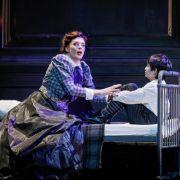
It was a delightful surprise to find young Australian mezzo-soprano Xenia Puskarz Thomas in the title role. She more than carried the part, inhabiting the role and producing powerful smooth and burnished tone. Her final lament, “Lasciate Averno”, was beautifully delivered and very moving, and after the last note faded, an extended silence prevailed. She was well partnered by soprano Julie Roset as Euridice, singing with crystalline purity and traversing the range of emotions from joyful young bride through beleaguered faithful wife to dying not just once but twice. As Aristeo, Orfeo’s rival for Euridice, mezzo-soprano Blandine de Sansal also turned in a riveting performance, both dramatically and vocally, with fine ringing tone.


In the non-mortal roles, Camille Chopin, a soprano with a charming sparkly voice, doubled as Venere (Venus) and Pluto’s consort, Proserpina. One of the more fun aspects of this version of the Orpheus legend is the latter urging Pluto to restore Euridice to the world of the living so he won’t be tempted by her. The king of the underworld, and the Augur were impressively sung by Alex Rosen with confident authority and some wonderfully sustained low notes. Dominique Visse has made a career as a comic countertenor and did not disappoint as Vecchia – Venus disguised as an old lady. Tenor Laurence Kilby had less to do as Apollo but sang extremely well, also Tomáš Král as Endimione/Caronte and tenor Samuel Boden as an entertaining Momo, god of mockery (and criticism!).