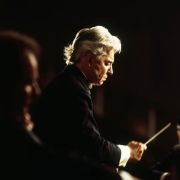
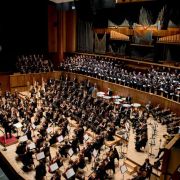
There’s a strange phenomenon that sometimes occurs when one has been away from their home country for a few years. Something that isn’t necessarily homesickness – and definitely not patriotism – but comes rather as a realisation. It’s a sudden clarity, revealing that the imprint of one’s country reaches deeper than they initially thought. In a way, this same feeling appeared to be at the centre of Franz Welser-Möst’s concert at the Berlin Philharmonie. With his decades-long tenure at The Cleveland Orchestra nearing its end, Welser-Möst returned to Berlin carrying a fragment of his Austrian homeland. The programme traced Vienna’s rich musical tradition through pieces that are dear to the conductor: Schubert’s Third Symphony, the German premiere of Bernd Richard Deutsch’s Intensity, and a suite from Der Rosenkavalier fashioned by Welser-Möst himself.


A well-known admirer of Schubert, Welser-Möst approached the symphony with a precise idea in mind – that the piece should be transparent and find its charm in simplicity. In the Third Symphony, the most fascinating, distinctive traits of Schubert’s idiom are still shrouded in the composer’s devotion to the masters of his time, namely Haydn and Rossini. Offering a crystalline, clear-cut interpretation, Welser-Möst complemented Schubert’s pleasant orchestration, but left something to be desired in terms of emotional involvement, both in quiet and animated moments. What suffered the most was probably the second movement, where a cheekier attitude could have provided the humour that the score encourages, instead of deflating in little more than a read-through. The best sections were the ones where the symphony required a less composed hand and left space to the soloists, like the rowdy tarantella of the last movement with its malleable harmonies or the whimsical Trio in the third.
On the other hand, such transparency benefited Deutsch’s orchestral piece. Conceived with Welser-Möst in mind, Intensity keeps the promise of its title. Despite its limited length, the score encapsulates some of Deutsch’s distinctive traits as a composer: a saturated architecture reliant on captivating, heavily percussive orchestral scoring. It’s easy to get lost in Intensity, but Welser-Möst seemed to find his ideal environment in it, thriving on the dynamic contrasts and constant timbral metamorphoses.


Much like a journey to the centre of a labyrinth, the orchestra made their way through the hectic beginnings to its contemplative core, where the tumult of the orchestral tutti, driven by four eager percussionists, thins out into a suspended pianissimo. Here, the score is laid bare in its basic elements – a few intervals and chords – giving Welser-Möst the chance to linger on the mesmerising mixture of harp, violins and low brass. However, the way out of the labyrinth brought back the initial vehemence, closing the first half of the evening with a rhythmic relentlessness worthy of the Moloch scene in Fritz Lang’s Metropolis.
Perhaps not aimed at Strauss aficionados such as myself, who would gladly let themselves be taken hostage for three hours, the suite from Rosenkavalier is still a good crash course to the opera, and a love letter of Welser-Möst to the composer. Each of the three movements covers a different act, making use of recurring themes to confer coherence to the whole. Welser-Möst’s graceful composure was an easy match for this portion of Strauss’ oeuvre, which thrives on limpid sonorities and a good pinch of ironic detachment. Ethereal, suave violins and high woodwinds were joined by a robust, full-bodied lower section of the orchestra, particularly the cellos and double basses. In this balance, the audience found a conciliatory ending to the evening.