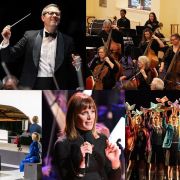
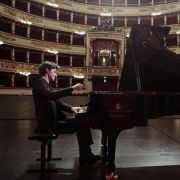
The torrential rain couldn’t dampen the enthusiasm for tonight’s Russian-dominated programme in Dublin’s National Concert Hall. John Wilson and the National Symphony Orchestra Ireland were joined by Bulgarian soloist Emanuil Ivanov in a concert that promised plenty of fireworks but also some introspective moments. From the outset, Wilson seemed determined to draw out both sides of the programme: the visceral energy of its big climaxes and the quieter, more reflective passages in between.

The opening work was the Overture by 20th-century Polish composer Grażyna Bacewicz. Composed during the Second World War, its first performance wasn’t until shortly after the end of the war in 1945. It has a cinematic feel to it – a hi-octane chase – with swirling strings and raucous brass. There are moments of respite too which Wilson highlighted; plaintive woodwinds spoke of happier, freer times and tender strings evoked a wistful sense of nostalgia. But these moments of calm were blown aside by the helter-skelter of the mounting scales on the strings and increasingly defiant percussion.


It's easy to see why Tchaikovsky’s Piano Concerto no. 1 in B flat minor, with its brash, galumphing chordal opening, has become the cliché of piano competitions, where Russians and Chinese vie over who can dispatch its thundering octaves passages faster and more furiously. What can be surprisingly difficult is to say something new and original that hasn’t been already said a hundred times before.
Ivanov’s approach was straight from the competition playbook; Formula 1 speedy octaves? Tick. Glistening scales? Check. Liquid arpeggios? Guaranteed. What was less in evidence was convincing lyricism capable of creating long, arching phrases and allowing the music to breathe and enchant us. The heart-on-sleeve second subject in both first and third movements were played with such metronomic precision that they acquired a mechanical quality. Rather than providing a moment of emotional release after the preceding virtuosity, these passages sometimes felt like simply another item to be dispatched accurately. Tchaikovsky’s melodies need room to stretch, linger and become expressive; here, Ivanov seemed more interested in their surface than their emotional weight.

There were fleeting moments of novelty; at times, Ivanov’s sparse pedalling in the bass revealed remarkable clarity in the muddy lower writing while the cadenza of the first movement had all the hallmarks of a live improvisation. It would be churlish not to commend his blisteringly hot octaves. The infamous final octave passage of the third movement had all the nimbleness of a Chamonix goat leaping with utter sure-footedness, combined with the speed of the young Horowitz.


If Ivanov resisted the urge to wallow in the work’s romanticism, Wilson was quite the reverse. He worked himself into a frenzy for the big final climax garnishing a huge swell of sound from the NSOI. The pianist seemed intent on conquering Tchaikovsky; the conductor, on surrendering to him.
I have to confess that I have never warmed particularly to Rachmaninov’s symphonies and tonight’s performance did little to change that view. Wilson elicited a haunting quality with the opening oboe while he caressed the later cello melody. For me, the music rarely seems to find its moment of arrival or climax. The abrupt changes in mood and tempo only reinforce this.
There were nevertheless some beautifully judged moments. The violin solo in the second movement possessed a bittersweet quality to it while the brass in the background oscillated between ominous and romantic. Wilson imbued the final movement with a sense of mischievousness which bobbed along with vim and no little energy. Wilson made the work sound most convincing in the surges of yearning allowing the excitement to mount through the extremes of dynamic contrast.