At around 45 minutes in length, Sibelius’ Second Symphony is a hefty statement. Although conceived in Italy and regarded by the composer as one of his sunniest works, there is for much of the piece a sense of suffering and angst, emphasised by bass-heavy orchestral textures which punctuate the lighter moments. It’s always hard to tell with this composer quite how drunk or hungover he was at the time (the Violin Concerto is said to have been written in the grip of a three day hangover) and claiming the inspiration for the woodwind melody just before the final brass climax in the fourth movement as having been his sister-in-law’s suicide, as the programme alleged, is possibly a touch too fanciful for a man who habitually composed with an open bottle on the desk.


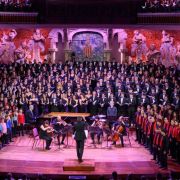
A much-augmented Royal Northern Sinfonia sounded authentically, moodily Scandinavian and there were some wonderfully chunky yet razor-sharp string passages. Woodwinds and brass were lively and chattered away like Sibelius’ favourite forest birds, despite a few accidents in the brass.
Earlier, the orchestra had given a full-blooded, bright and suitable patriotic version of Finlandia. There were some genuinely moving moments in what felt, in retrospect, to have been the highlight of the evening, a tightly disciplined work given a tightly disciplined performance under the direction of Thomas Zehetmair, RNS’s Conductor Laureate. Zehetmair is an authoritative presence on the podium, holding himself like an athlete, sure of hand and light of foot. He is a superb technical conductor and particularly adept at signalling changes in tempo or dynamic without ever interfering with either the orchestra’s concentration or his own. If he was perhaps too fond of the louder or more vivid sounds the orchestra could make then the culpability had to lie with the composer, as no such over-cooking was evident in the second item, Felix Mendelssohn’s youthful Violin Concerto in D minor.


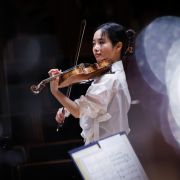
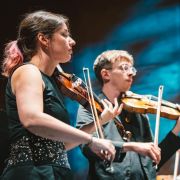
I found it surprising that Zehetmair chose to conduct from the violin, the extreme technical demands of the more virtuosic passages making it all but impossible to indicate at all times exactly what he wished the orchestra to do. He played with a fine sense of the volume and tone needed to fill a full house, and there were some truly exciting moments. The work, essentially a pastiche of early Classical style, is discursive, and unbalanced by the length of the first movement. Considered as a whole it is a marvel to arise from the mind of of a 13-year-old, but possibly more of a curio when resurrected in our day. The RNS strings were clear and direct, giving an honest, committed account of the complicated and, at times, dense textures.