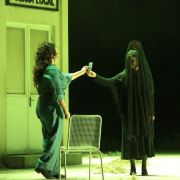
The enduring popularity of Carmen, despite the notorious failure of its 1875 premiere, rests on a unique and perfect balance between Bizet’s score – rich in melodic invention, rooted in realism yet still imbued with Romantic sensibilities – and its powerful dramatic portrayal of passion, obsessive love and female self-determination. Damiano Michieletto’s co-production with the Royal Opera House in London and Teatro Real in Madrid has now turned up at La Scala, but ultimately fails to convince.

The narrative is severely weakened by the removal of all spoken dialogue, reducing the opera to a medley of famous melodies with little explanation of the characters’ actions, motivations or emotional development. Even more regrettable is the omission of the trio and chorus “Quant au douanier c'est notre affaire”, one of the score’s most delightful numbers, perhaps deemed too light-hearted for Michieletto’s relentlessly bleak vision.
The action is relocated to the 1970s, as suggested by Carla Teti’s uninspired costumes, in a setting that could be virtually anywhere in the world. This temporal shift appears to serve no discernible dramatic purpose. Paolo Fantin’s stage design consists of a revolving platform with a simple hut standing in a desolate wasteland. In the first act it serves as a small police station, in the second as Lilas Pastia’s tavern, in the third as a weapons storehouse for the smugglers and, in the fourth, as the toreadors’ dressing room.
The visual atmosphere is oppressively gloomy, dominated by a permanent pitch-black backdrop and an overwhelming sense of impending doom. This mood is reinforced by the recurring appearance of a ghostly figure: a veiled elderly woman in mourning attire – Don José’s mother – who enters at key moments carrying a tarot card, symbolising the inescapable fate driving the tragedy. There is little sensuality, seduction or genuine passion. Even Carmen’s death, here by strangulation rather than the usual stabbing, is rendered with particular darkness and brutality.

In the pit, Myung-whun Chung offered a reading of the score that demonstrated profound understanding of Bizet’s music. The La Scala Orchestra produced a brilliant, richly textured sound, radiant in warmth and shaped with remarkable expressive intelligence. Chung downplayed the score’s most overtly sensual elements, instead highlighting the full emotional spectrum embedded within the music. Ethereal passages alternated with violent outbursts, always handled with elegance and meticulous attention to phrasing, revealing much of what, regrettably, was absent from the staging.
A veteran of the title role, Clémentine Margaine portrayed Carmen with a warm mezzo-soprano of coppery hue and impressive top notes. However, the voice became constricted in the area just below the upper register, leading to occasional intonation issues and a loss of focus. Nevertheless, the Card Scene proved deeply moving and compelling. Her Carmen lacked playfulness, flirtation and spontaneity; while her sensuality was conveyed without vulgarity, it was also devoid of lightness, likely the result of the director’s conception rather than the singer’s own interpretative choices.

Vittorio Grigolo’s Don José benefited from a tenor in remarkably fine condition, particularly his upper register, which sounded bright and focused throughout. His acting, however, was once again excessively demonstrative, relying on a limited repertoire of repetitive gestures that eventually became distracting, undermining an otherwise strong vocal performance. He produced a beautiful pianissimo at the conclusion of the duet with Micaëla (Natalia Tanasii), while in the Flower Song – best appreciated, perhaps, with one’s eyes closed – he crowned the aria with a full, centred B flat. Michieletto presents Don José as an excessively nervous, anxious, volatile man, a characterisation that remains broadly consistent with the role.
Tanasii sang Micaëla with a sweet, lyrical soprano, effectively capturing the character’s youth and innocence. However, her performance lacked the almost angelic quality that makes Micaëla José’s true opportunity for redemption. The production does little to help in this regard, portraying her as an awkward, devout church girl dressed in modest, almost nun-like clothing. She nevertheless excelled in her aria, culminating in a glorious high B. Making his role debut as Escamillo, Giorgi Manoshvili appeared somewhat ill at ease. Physically, he is an ideal toreador – dark, handsome and commanding. His bass is smooth, attractive and never forced, but this repertoire may not yet fully suit him, as his performance lacked some of the swagger and charismatic presence essential to the role.

Among the smugglers, Marine Chagnon (Mercédès) and Sarah Dufresne (Frasquita) delivered highly enjoyable performances, portraying two perpetually intoxicated night owls while maintaining elegance and musical precision, particularly in the Card Scene. Baritone Pierre Doyen was a solid Dancaïre, while Loïc Félix impressed as Remendado with a bright, appealing tenor, rich in squillo. The La Scala Chorus once again demonstrated its customary precision and refined dynamic control. Special mention must go to the children’s chorus, which sang with admirable commitment, energy and joy.