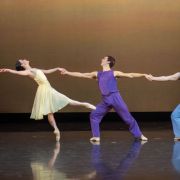
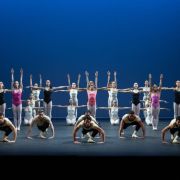
This enterprising and innovative double bill from Alexander Whitley Dance Company continued Whitley’s adventure into the potential impact of technology on dance. This iteration also explored a futuristic approach to one of dance’s historic scores.

The Rite of Spring has become a rite of passage for choreographers, with countless attempts to align Igor Stravinsky’s ferocious music to human movement. It’s hard to imagine any angle that has not been explored in the plethora of choreographies that have gone before but a part of Whitley’s singular approach is to create a spidery corps de ballet by generating motion capture via some fifty or so sensors on each of his five dancers.
Before Rite, this technology was the foundation for Mirror, inspired by Shannon Vallor‘s book The AI Mirror, which essentially asks how we can reclaim our humanity in the age of machine thinking. It seemed ironic to evidence this through dance that leant heavily on technology.
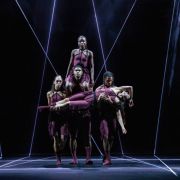
Mirror employed just two human dancers, Gabriel Ciulli and Daisy Dancer, who began the work on extremes of the circumference of a light circle, contained within a structure of thin poles, marking out the territory like a circus ring, which carried the seven infra-red cameras that captured and regenerated their motion


As the light circle narrowed, the two dancers moved towards each other, wearing tight fitting costumes with pronounced spinal columns, just some of the sensor protrusions. Dancer had the addition of something like a swimming cap with the same nodules. Other sensors were cleverly hidden in Mirella Weingarten’s costumes.
The onstage dancers performed as the filling in the sandwich between projections of their captured motion on a front scrim and backdrop, most often simultaneously. The impact of closing the fourth wall and projecting motion capture imagery onto both it and the back wall gave the impression of the onstage dancers performing inside a transparent cage and from time-to-time the live performers were dwarfed by the multiplicity of their avatars (all of which were featureless).
The variety of this imagery spanned computer code and algorithms, and the proliferation of non-human avatars, from exact facsimiles of the live performers multiplied into an army of thousands. At one point it seemed like the projections showed an overhead camera filming a rave. At another, the dancers’ shapes emerged out of cosmic clouds. The input of the creative technologist, Luca Biada was clearly as significant as the choreographer himself.

A brief interlude of a woodland glade reminded me of Winston Smith’s escape from Big Brother with Julia in George Orwell’s 1984. Later images seemed to portend the world’s end by showing a landscape on fire.
Over almost an hour’s duration, the several sections of the work presented a number of false endings, perhaps a few stop-starts too many. Dancer’s character exited the stage leaving Ciulli alone for a long, anguished solo, characterised by swivelling flowing movement, which may have indicated humanity’s inexorable journey to the exit. However, Dancer’s return represented a sensitive reunion, the pair touching intimately while turning gently, moving erotically together as one, evidence of humanity’s revival.
Comparing Stravinsky’s coruscating score for The Rite of Spring – easily one of the most important dance scores of the twentieth century – and Galya Bisengalieva’s new score for Mirror is patently unfair. But that the latter seemed over-long wasn’t helped by the music, which was at least diverse with different themes to represent the various sections. The images some of these sounds suggested ranged from a bee trapped in a watering can, the rattling reverberations of the northern line between Camden Town and Mornington Crescent and a ghostly church organ stuck in the same chord for several minutes. That said I liked the more lyrical music for the concluding section, which was beautifully danced.


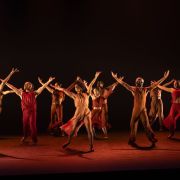
The Rite of Spring achieved the rare distinction of offering a fresh approach and one that showed Whitley’s choreographic language to best effect. It’s also rare to see the work performed by just five dancers (Ciulli and Dancer returned to be joined by Nafisah Baba, Natnael Dawit and Elaini Lalousis) all wearing skintight costumes. Whitley’s choreography seemed more expansive than I recall, perhaps necessitated by the technological requirements and he managed to nail the complexities of the score in a mix of literal and counter-intuitive movement that always seemed to retain musicality.
There were some unusually ponderous moments in the opening section of Mirror, and I wondered if something wasn’t quite right. There is significant risk in the unpredictable variables of the live interaction of onstage dancers with avatars captured through real-time generative imagery to produce simultaneous digital movement.
Whitley isn’t alone in this journey to explore society’s increasing dependency on AI in dance. But he has certainly invested heavily to be at its cutting edge and that commitment to innovation is to be applauded.