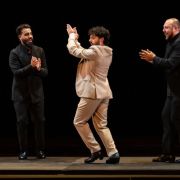
Born in the COVID era, BAAND Together outlived the pandemic and continues to attract fans of five popular New York dance companies to a shared stage. It’s a younger, buzzier crowd than usually encountered at the Koch Theater – thanks in part to an enlightened pay-what-you-wish ticket pricing model. With devotees of five different companies converging to root for their home team, there was a hint of healthy rivalry in the air on opening night – and the festive air of a gala minus the usual posturing, but with children. The audiences of tomorrow at a dance event that is not The Nutcracker was a rare and heartening sight.

Disheartened once again that the companies stopped short of collaborating on a work. They did so only once, in the festival's second edition, when Annabelle Lopez Ochoa made a work for dancers from all five companies. It was a blast. Hope dies hard.
The solidarity BAAND Together aspires to found its most compelling expression in Cassi Abranches’ Trança (Braid) for Ballet Hispánico. Premiered this spring, it wove sweeping contemporary movement with Brazilian vernacular and street dance to an exhilarating acoustic-electronic score by Beto Villares. At its most breathtaking, the movement seemed to transform the dancers into forces of nature – Francesca Levita into a butterfly, Dylan Dias McIntyre into a gale. At other moments they strutted in formations that alluded to ritual. As dusk fell, they walked in place in slow motion, each in a private world, the gatherings precious but ephemeral.


An ensemble shadowed by an unspecified calamity took shape in Jodie Gates' Passage of Being, premiered by Dance Theatre of Harlem in 2025. The beguiling choreography unspooled in swirling lifts, spring-loaded jumps and urgently fluttering arms set against baffling lyrics. “All the shadows dancing on our walls belong to us / And our candles are the only light we'll see tonight” suggested a massive power failure, Ryan Lott’s quavering voice and Son Lux’s otherworldly strings further deepening the mystery. Alexandra Rene Jones sailed over perilous terrain, Kamala Saara grappled against an unseen oppressor, while Derek Brockington made a noble, steadying presence.

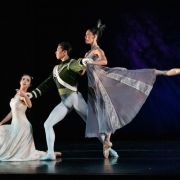
American Ballet Theatre corps de ballet member Claire Davidson made her mainstage choreographic debut with the program’s lone world premiere, Zephyr, a terrific showcase for the exquisite Fangqi Li, sensitively partnered by Joseph Markey. They had the look of a young couple in the early, smitten days, drifting gorgeously together and apart, undeterred by Mark Saya and Piers Lane's jangly score, which seemed to contort barcarolles by Offenbach and Chopin. Why pianist Jacek Mysinski was shunted off to the apron when the pianist for the New York City Ballet duet occupied prime real estate upstage center was a mystery. The stage wasn’t exactly crowded, and placing Mysinski onstage might have lent the conventional scenario a bracing air of ambiguity.

Dance and score seemed to spring from a single impulse in Lar Lubovitch's Each In Their Own Time, a pandemic-era creation that premiered at Fall for Dance in 2021. Here, pianist Ruoting Li was the gravitational center of the piece, laying bare the turbulence and introspection in Brahms. NYCB’s Adrian Danchig-Waring and Taylor Stanley, both soon to retire from the company, swooped in and out of each other's orbit, always on the edge of balance, their handholds shifting with mesmerizing fluidity as their arms inscribed arcs and circles overhead. Stanley clung momentarily to Danchig-Waring in a tense, contracted lift; by the end, their roles reversed, and it was Danchig-Waring who anchored his partner, gripping Stanley’s ankle as though he might otherwise fly off.


Alvin Ailey stalwarts Jacquelin Harris and Yannick Lebrun risked everything in a sensational bout of virtuosic partnering in Judith Jamison’s A Case of You. The dense poetry of Joni Mitchell’s lyrics – widely believed to have been inspired by her romance with Graham Nash – delivered with smoky intensity by Diana Krall, and piped in too loudly, could easily have overshadowed the dancing. It didn’t. Jamison knew how to make every moment count: the dramatic stillness, the frantic wrestling, the fierce jumps, through to the ambiguous close, when the couple stared intensely at each other as he gripped her stretched-out form between his knees. Mitchell reportedly ended the affair with a telegram from Europe. Jamison left the ending suspended in midair.
BAAND Together emerged as a response to a virus that threatened to wipe us all out. Today, with American arts institutions in the crosshairs of a hostile administration, its idealism remains urgent but elusive. Five companies, each navigating its own vulnerabilities in the shadow of a petulant strongman, risk more than ever by dancing to their own drummer.