A fine escapist evening at New York City Ballet harnessed two monster pieces, polar opposites in mood, that bookended two taut duets elevated by dream casts. Opening night belonged to corps dancer Ruby Lister, debuting in Edwaard Liang’s Distant Cries, in a role created on Wendy Whelan some 20 years ago. Limbs thrust sharply from a rippling core then drawn inward with buttery softness – Lister’s interpretation shaded memorably between ethereal and incisive.

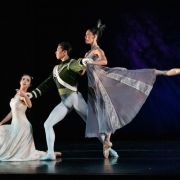
Distant Cries inhabits that crowded genre of gloomily lit pas de deux that leave a couple’s shared reality in doubt. Lister and Chun Wai Chan, one of the company’s most generous partners, were costumed as if for two different ballets – Lister in a silky, ombré shift, Chan in nothing but black yoga pants – but the disconnect felt intentional. They partnered at an eerie emotional remove, as if one were a memory or mirage, a figure momentarily ‘captured’ while swimming through the air.

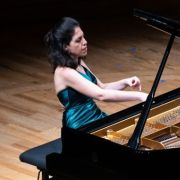
Stalwarts Taylor Stanley and Adrian Danchig-Waring starred in Lar Lubovitch’s COVID-era reverie, Each In Their Own Time, offering lush, heady dancing stripped of sentimentality. The valiant Hanna Hyunjung Kim steered the enterprise from the piano’s central perch onstage, cascading through Brahms in alternately restless and dreamy moods; to this, Lubovitch strung airy steps in his signature manner: nonchalant, loose-limbed, yet impeccably precise. Both dancers’ impending retirement – Danchig-Waring in the fall and Stanley in the winter – lent poignancy to an outing in which they hovered in each other’s orbit but connected only intermittently: Danchig-Waring the more somber and dramatic, Stanley the more mercurial.


Opening night was also a triumph for the four couples in Christopher Wheeldon’s Continuum, a work of austere architectural elegance making its New York premiere. Created on San Francisco Ballet in 2002, the piece remains etched in my memory through a succession of daredevil casts with singular movement qualities. By contrast, this New York City Ballet lineup – David Gabriel and Emma Von Enck, Gilbert Bolden III with Unity Phelan, Alexa Maxwell and Davide Riccardo, and Mira Nadon with Ryan Tomash – leaned toward a haunting uniformity, as if to preserve anonymity in a precarious world.
Its Brutalist edge is burnished by György Ligeti’s cerebral music in which piano and harpsichord resonated like bells, drums, horns and rumbling trains. The opening episode declared its ambition as the men hoisted their partners into expansive ‘X’ shapes – as if gleefully catching a thermal yet, like Icarus, flying dangerously close to the sun. The dancers conquered the cantilevered balances, extreme hinging, pinwheeling, braiding and crumpling, that evoked both mechanical efficiency and the instinct to shelter one another in times of duress. In a duet replete with intimate holds, the most sensual moment came when Bolden and Phelan knelt and rolled their heads along each other’s shoulders.

In one evocative encounter marked by lighting-induced claustrophobia, Maxwell and Riccardo gingerly traced an invisible wall of glass before seeking to tunnel through. In another, Tomash dragged Nadon through precipitous promenades to the siren-like drone of the harpsichord.
Yet despite the often frenetic pace, an air of serenity prevailed, along with an undercurrent of humor – as if the dancers were as bemused as the audience by the oddities they were sculpting.
Alexei Ratmansky’s Concerto DSCH has long been part of New York City Ballet’s DNA, created before he relinquished the directorship of the Bolshoi ballet in 2008. Baked into both the ballet and its Shostakovich score are depictions of athletic Soviet vigor, propelled by relentless cheerfulness and conviction, and fleeting images of individual resistance to repression. It evokes a world that feels far less treacherous than our own.


Today, a glowing Unity Phelan, recently returned from maternity leave, stepped into the role originated by Wendy Whelan. During the second movement’s tender assignation with the noble Adrian Danchig-Waring, he pressed her overhead with one hand beneath a tautly stretched leg; for a moment, one believed she might ascend to the heavens.
The fleet-footed, high-spirited trio of Indiana Woodward, KJ Takahashi and Roman Mejia tore through playful, virtuosic assignments. Woodward played hide-and-seek, emerging from a spinning ‘wheel’ of dancers in a whirlwind of turns, her speed and vivacity muddied only by wildly flapping hands – a habit endemic to the company.

Opening night was messy but exhilarating and belonged firmly to the ensemble, clad in vivid high-desert earth tones, amplifying the soloists’ moves but more often absorbed in their own riveting celebrations and dramas. Ignoring the concept of personal space, they staged entrancing distractions and fractured the central pas de deux. From mournful rituals recalling Bronislava Nijinska’s Les Noces, to swirling romantic entanglements and time marked by hilarious flat-footed bounces – like those of restless, attention-seeking children – they built a chaotic, shimmering landscape. The work teems with such scattered brilliance that repeated viewings are needed to catch its concurrent mini-dramas.