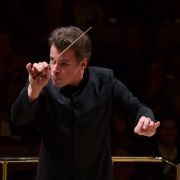


The crowd inside Sheffield’s City Hall for this concert by The Hallé under the elegantly wielded baton of Nicholas Collon was sparse indeed, possibly a consequence of autumnal storms sweeping the country, although this was a programme without an obvious crowd-pleaser. Instead we got an opening work receiving only its second performance, a concerto last heard in Sheffield many decades ago and the least popular of Rachmaninov’s final three orchestral works. However, those who braved the elements and who like their listening experiences to be at least a little off-piste were rewarded with some excellent playing from an orchestra on impressive form, and a soloist, the orchestra’s Co-Leader Emily Davis, who evidently has a special fondness for Szymanowski’s Violin Concerto no. 2.


The main work of the evening was Rachmaninov’s Third Symphony. It’s a piece that’s rarely been truly loved, Rachmaninov himself observing that “It has been heard once in every capital in the musical world; it has been condemned in them all.” Why that should be so – apart from the obvious fact that it isn’t his Second Symphony – isn’t clear. Collon and the Hallé gloried in its subtle sonorities, complex rhythmic attack and its absolute refusal to wallow in anything resembling sentimentality. Right from its haunted, elusive opening, with muted horns, high clarinet and a solo cello playing that mesmerically circling opening theme, this was a performance that foregrounded the work’s orchestration, drawing some wonderful playing from right across the ensemble: crisp brass interjections, skittering woodwind figures and a full-bodied string sound that positively glowed in those occasional moments when Rachmaninov does allow himself to look back fondly to the past, as in the lush cello second theme of the opening movement. The work’s conclusion, when the inevitable Dies irae plainchant steps from the shadows into the foreground, felt like a deeply ambiguous affirmation here, before Collon let off the handbrake and the orchestra sprinted to the work’s jolting, syncopated conclusion.
Szymanowski’s Violin Concerto no. 2 was his final work, though there’s nothing particularly valedictory about it. On the contrary, it fizzes with folk-music inspired life, especially in the latter half of its single continuous span, where the echoes of the music of Bartók are prominent. It has been in soloist Emily Davis’ repertoire for some time, and she played it with commitment, passion and no little dexterity. Its sinuous opening Moderato section unfolds like one continuous melody, and if Davis’ violin was occasionally submerged by the thicker textures of the orchestra, that seems to have been Szymanowski’s intention at those moments when waves of orchestral sound crash into each other before the soloist emerges again, still spinning that elusive, resilient thread. The cadenza that separates this opening from the latter half of the concerto is a testing, rigorous statement of intent that leads directly into the folk-fiddling idiom of the rest of the work. Davis had it under her fingers securely, and overall this was a powerful performance of a work that it would be good not to have to wait decades to hear again in these parts.


The concert opened with Colin Matthews’ orchestration of three diverse songs by Ravel, an 80th birthday present for Matthews’ older brother, David. Matthews has form in this area, having scored all of Debussy’s piano Préludes for the Hallé. Strong echoes of Debussy dominated the first song, Les grands vents venus d'outremer, but afterwards it was the Ravel of Ma Mère l'Oye that dominated proceedings, all enchanted woodwind, celeste and shimmering harps.