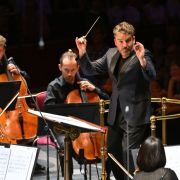
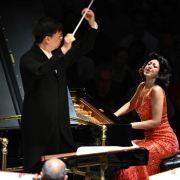
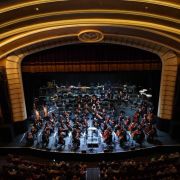
Making a welcome return to the Buxton International Festival, The Hallé, led by its Assistant Conductor and Hallé Youth Orchestra Music Director Euan Shields, brought a programme of Weber, Richard Strauss and Brahms to the town. While the first half brimmed with youthful freshness and enthusiasm, Brahms’ Fourth Symphony demanded a deeper level of subtlety than Shields brought in this performance.

The Octagon is an unforgiving acoustic that demands careful handling. The overture to Weber’s Oberon opened with real delicacy from the horns and strings, but once the first fortissimo arrived the sound expanded too readily. Brass and woodwinds sadly overwhelmed the strings, at times almost obscuring them and some of their finer articulation. Shields employed rubato thoughtfully, although a more pronounced approach might have given the music greater flexibility and drama, especially in this acoustic.


Horn soloist Annemarie Federle joined The Hallé for Richard Strauss’ youthful First Horn Concerto, making an impressive statement from the opening Allegro. Each phrase was shaped with subtle shifts of colour and a strong sense of architectural line, while she judged the hall’s acoustic intelligently. Performing with poise and assurance, Federle immediately drew the audience into Strauss’ score. Increasingly, however, there appeared to be a lack of chemistry between soloist and conductor, which may have been to her positioning so far in front of the orchestra. Federle invited intimacy, while the orchestra often seemed to resist rather than respond. The accompaniment was more than competent but lacked the refinement and expressive imagination of the solo line. The Andante drifted aimlessly, but the closing Allegro restored focus and vitality.
Brahms’ Fourth Symphony is a work of immense structural strength, yet beneath its solid exterior lies extraordinary emotional depth. Shields delivered a performance that was assured and well constructed, though the finer nuances were disappointingly not always fully realised. The opening Allegro non troppo was sensibly paced, with the first subject carefully shaped, yet it lacked the sense of yearning and mystery that makes the arrival of the major-key second subject so affecting. The development felt slightly constrained and academic, and a broader conception of the non troppo marking could have allowed greater expressive freedom.


The Andante moderato was taken a little too slowly, diminishing the gentle rocking motion of its compound metre and occasionally making the music feel more mechanical than flowing. The third movement, too, suffered from the hall’s swimming-bath acoustic. Brass and woodwinds dominated the texture, while the triangle, positioned at the very back of the platform, was scarcely audible. By contrast, the finale possessed considerable drive. Brahms’ concluding passacaglia requires both structural command and meticulous attention to colour as the variations unfold. Shields undoubtedly has the technical control to shape the movement convincingly, but some gradations of colour needed more nuance to be totally convincing.
Shields is a dynamic conductor whose energy and commitment were never in doubt. His conducting was precise and disciplined, but this repertoire – in this acoustic – needs more balance than we got today.