Claus Guth's staging of Mozart’s Le nozze di Figaro hasn’t grown old since its initial appearance at the 2006 Salzburg Festival. The production, later acquired by the Canadian Opera Company, has now been revived by the Teatro dell’Opera di Roma. Its markedly abstract qualities are certainly what gives it longevity.

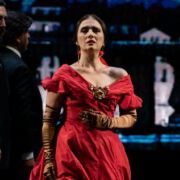
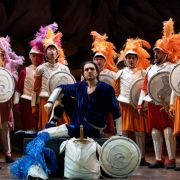
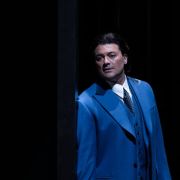
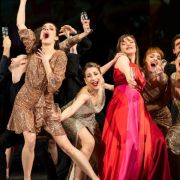
The curtain opens on Christian Schmidt’s classic setting of a timeless mansion interior, complete with detailed boiserie and an imposing staircase. But this apparent realism pretty soon reveals itself merely as a reassuring canvas not only for the story, but for its symbolic reading as well. The characters wear black and white contemporary clothing (also Schmidt) and, somehow, we have the impression that it is not the wording of the text that interests the director. What initially look like mere oversights, we then understand are the defining quality of Guth’s vision for this opera: an abstract, rarified atmosphere. Not the action, but the psychology behind the action. Not what librettist Lorenzo Da Ponte writes, but what the characters feel.


And so it happens that Susanna doesn’t wear any hat in the first scene (she actually uses a curtain to simulate a hat!); she doesn’t play a guitar when Cherubino sings; and Marcellina doesn’t hug Figaro when she is supposed to hug him. There are two instances of a sexual interpolation in the text. The first is the hiding of Cherubino by Susanna in the Countess’ bedroom, where the scene shows something certainly not implied in the libretto, but the underlying erotic tension between the three characters. The second is the scene between Figaro and Susanna in the garden, just before they are found out by the Count.

The core concept and dramatic engine of Mozart’s opera is made visible here as a supernatural, allegorical character: the doubling of Cherubino by a mute, winged cherubim, played by actor and acrobat Uli Kirsch. He represents, in the words of the director, “the anarchic energy of Eros which is creating chaos in the music and in the people”.
The musical direction was entrusted to the young but very talented conductor (and former violinist), Emmanuel Tjeknavorian. He made a brilliant display of his skills in the famous overture, which sounded fresh and crisp but, very modestly, he did not stop to take deserved applause and went straight to the first act, the curtain having opened before the overture was finished.

There was a slight feeling that more attention had been paid to the orchestral side rather than to the vocal one, resulting in a lack of subtlety in the singers’ phrasing at times, especially at the beginning of the opera and in the first arias of both, Cherubino (“Non so più”) and the Countess (“Porgi amor”). The general standard of the cast, however, was exceptionally high with many outstanding performers, starting with rising star Martina Russomanno in the role of Susanna. Russomanno has it all: good voice, perfect intonation and projection, sensitive acting and intelligent stage presence.


The main male roles, covered by two South-American singers, were equally satisfying. Germán Olvera, with his dark, resonant and flexible baritone, was perfect in the role of Count Almaviva, while bass-baritone Erwin Schrott was a cunning Figaro. Elmina Hasan was another highlight of the evening, lending to Cherubino her sweet, velvety tone and moving with the necessary verve on stage. Roberta Mantegna’s performance as the Countess was uneven. While she has a very pleasant timbre, her soprano became metallic approaching high notes, and neither of her arias convinced. She was, however, very good in the “Sull'aria” duet with Russomanno. Among the secondary roles, all well taken, I will mention two: the sparkling Marcellina of Monica Bacelli and the lively Barbarina of Jessica Ricci, who is going from strength to strength in the company’s Young Artist Programme.
In conclusion, a very satisfying evening with excellent music, a well chosen cast and an interesting directorial take on a classic, albeit a bit more cerebral than dramatic.