In many ways, Handel’s Giulio Cesare in Egitto is the perfect festival opera. It’s packed with zinging tunes right from the start and, trimmed with a few judicious cuts (arias and some da capo sections) to three hours, it isn’t overly lengthy. In a production that doesn’t take the plot too seriously, its appeal is widespread.

The opera’s best-loved festival outing is Sir David McVicar’s classic British-Raj-meets-Bollywood staging at Glyndebourne. One senses David Alden striving for a similar vibe in his new production at the Grange Festival. The anachronistic costumes – Achilla in modern military uniform, chest studded with medals, while Caesar’s general Curio dons Roman armour and plumed helmet – are entertaining enough, but there are times when Alden’s show feels like a cheap McVicar knock-off.
There’s nothing inherently wrong with that – imitation is the sincerest form of flattery – but where McVicar’s tongue is only in his cheek occasionally, Alden treats Handel like slapstick, slathering on the gags with a trowel.


Take Cesare’s celebrated aria, “Va tacito”. McVicar choreographs the cagey diplomacy as a symbolic dance, during which Curio sniffs at the drinks served and tactfully warns his master that it’s poisoned. Alden turns it into a game of Musical Chairs – amusing enough to portray Tolomeo’s petulance – but has not one, not two, but three attendants dying after sampling the deadly canapés. Subtle it ain’t.

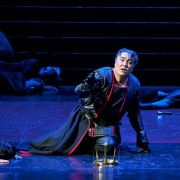
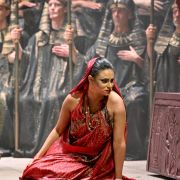
Designer Jon Morrell raids the dressing-up box for a mish-mash of eras: Sesto begins as a 50s schoolboy before donning American footballer shoulder pads and war paint; Cesare wears cotton drill uniform but with gold laurels; Cleopatra is a Goth teenager, fondling her pet asp, before sporting a Louise Brooks-style bob as “Lydia”, a Victorian maid doing suggestive things with a feather duster. Nireno emerges from a sarcophagus, bandaged from head to toe as a mummy, like an extra from Raiders of the Lost Ark (expect also hieroglyphs, scarab beetles and a troupe of male dancers in niqabs).

Alden has a fetish for rubber snakes. Cleo uses her asp to mock strangle Cesare during “Da tempeste” and, during separate suicidal arias, both Cornelia and Sesto clamber into a vivarium. Tolomeo in a leaf-print suit camouflaged against his own wall is a good gag, though, and Cleopatra singing “Se pietà“ on a khufu ship with Anubis as the ferryman cuts a striking image. A stage revolve keeps the action flowing until a tediously long front-of-curtain sequence during which you wonder what kind of stage spectacle awaits the audience. It is a pile of rubble.


Countering the overkill of humour, the vocal performances were largely excellent. Irish soprano Sarah Brady was the complete package as Cleopatra, displaying an incredible palette of colours, spunky coloratura, bending notes for emotive effect. In a sequined gown, surrounded by a ‘ballet of inflatable spheres‘, her “V’adoro pupille” was truly enchanting. Tim Mead’s Cesare suitably spent much of the performance giddily enraptured. His honeyed countertenor displayed warmth and agility, “Va tacito” a classy bit of singing, echoed by a similarly classy obbligato by Ursula Paludan Monberg, standing in the pit, horn raised aloft. The laser-like tone and purity of Hugh Cutting’s Tolomeo made an effective foil to Mead’s Cesare, a cheeky chappie who turns psychotic at the flick of a switch.

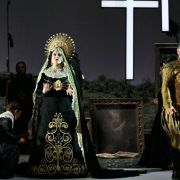
Jess Dandy’s rich contralto impressed as a dignified Cornelia, while Zheng Jiang’s slight but limpid countertenor made for a pleasing Sesto, the two blending beautifully in the duet “Son nata a lagrimar”. James Atkinson’s muscular baritone made for a menacing Achilla. Tristan Hambleton’s Curio and Owen Willetts’ Nireno (sadly deprived of his aria) shouldered a lot of the production’s comic burden.

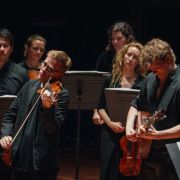
Christian Curnyn directed the Early Opera Company in a shapely account of Handel’s miraculous score, nicely paced, neatly articulated and attentive to the singers’ needs. Musically marvellous and, if you can stomach Alden’s comic overkill, a near-perfect festival evening.