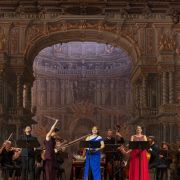
The opera world recently recoiled at Hollywood star Timothée Chalamet’s dismissive remarks regarding ballet and opera. Yet, it is evident that in this age of entertainment surplus, opera indeed faces significant competitions to audience attention. Serving as the box-office anchor for the inaugural Zürich Barock 2026, Opernhaus Zürich’s revival of the 2024 Wiener Staatsoper production of Giulio Cesare tackles this challenge head-on. Powered by superstars like Bartoli, Vistoli, and Cenčić, Davide Livermore’s staging treats Handel as a cinematic blockbuster. However, regarding the integration of music and drama, as well as the actual quality of the musical performance, much remains open to debate.

The production establishes a high-glitz tone by relocating the action to an Art Deco Nile cruise ship, with crowds in period suits, flowing dresses, and naval uniforms. The ship balcony provides the dominating platform for a grand, Hollywood-style visual effect. Throughout the performance, this physical set is supported by a restless barrage of digital projections—alternating wildly between desert landscapes, peaceful temple-lined rivers, turbulent seas, and violent aerial bombardments. While these shifting backdrop moods undeniably reflect the progress of the plots, they function primarily as an entertainment mechanism. Should you seek a chiseled, intricate correlation with the music’s rhetorical structure, or a compelling internal logic within the visual display, you are likely to be disappointed.


The dramaturgy of this production clearly prioritises the star turn over structural fidelity. The score has been somewhat tailored to prioritise the showpieces of Bartoli and Vistoli, while some other arias are stripped of their Da Capo repeats. The most indulgent example occurs after Caesar is captivated by Cleopatra; here, the narrative halts for an extensive cruise-ship nightlife show. In this sequence, the stage is bathed in dramatic, saturated red lighting and filled with floating white balloons as Vistoli, in a sharp white tuxedo, sings with a smooth, microphone-led allure. His interaction with a violinist wearing a fez undeniably captures the eye, yet like so many moments in this production, the musical fluidity and the natural momentum of Handel’s score is frequently interrupted by forced comedic bits – diversions that feel like a calculated lowering of artistic stakes, serving more to appease a restless audience than to realize the dramatic potential.

The vocal performance itself is a similarly mixed bag. Bartoli is evidently on familiar ground; her Cleopatra conveys confidence, coquetry, the sting of defeat and the shifting emotions of the final reversal with exceptional clarity. However, certain slower arias resorted to sluggish tempi to express grief. While this secured more stage time, it lacked genuine convincing power. Furthermore, her Da Capo embellishments often felt perfunctory, frequently settling for simple, scale-like transitional passages. The veteran Anne Sofie von Otter remained generally lukewarm. Her Cornelia did not erupt; instead, she projected a noble, restrained aristocratic air. Her performance was most engaging where her affirmation of Sesto finally coming of age as a man feels particularly poignant.

Carlo Vistoli, as always, fully demonstrated his unparalleled vocal and theatrical capability. Yet, much like the (fictionalized) Handel’s yearning in the film Farinelli – wishing for the singer to perform music of greater artistic depth – I found myself wishing that Vistoli were supported by a production with higher artistic intentions. Max Emanuel Cenčić faced the same dilemma: his Tolomeo possessed the potential of a calculating, venomous viper, but was similarly undermined by the production’s overarching lean toward comic entertainment. However, the performance of Kangmin Justin Kim as Sesto was stunning; the trajectory of the character's growth was traced with rare clarity, even if his assigned stage business was awkwardly dominated by a series of stumbling runs.


Gianluca Capuano remained remarkably keen on crafting entirely new embellishments or distinct re-paraphrasings for Handel's music. However, the appeal of this novelty failed to sustain itself throughout the entire performance; more importantly, this approach found no equal match in the vocalists' performances. Orchestra La Scintilla generally presented the opera with a boisterous energy, full of hormonal drive and explosive power, yet it ultimately lacked a sense of refined temperament. The basso continuo was equally underwhelming; in many passages, the execution felt scattered and the textures remained disappointingly thin.

To sum up, if one did not see the 2024 Vienna production and is a devoted fan of these superstars, this performance is undeniably impressive. However, a true lover of Baroque opera – especially one hoping to extract a lasting, thought-provoking artistic experience from this Dramma per musica masterpiece that is, unfortunately, somewhat overexposed – will likely feel it is more inclined to be an over-processed evening of entertainment; a Baroque alternative to Netflix.