Two piano concertos written just a few years apart, both in the key of A minor, both of which started out as single movement works, the composers husband and wife. Clara Schumann was still Clara Wieck when she completed her concerto, twelve days before her 16th birthday. By the time she performed the premiere of Robert’s concerto in 1845, she was Frau Schumann. Russian pianist Alexandra Dovgan pitted the two concertos head-to-head in the Kammerorchester Basel’s tour stop at the Wiener Konzerthaus – but it was a third composer who snatched a surprise victory between this battle of the Schumanns.

Dovgan already has the maturity and poise of one well beyond her tender 18 years; but then, she had a head start, accepted into the Moscow Conservatory at the age of five. She’s an assured performer, undemonstrative, with soft hands and wrists, although there are flashes of steel when required. Occasionally, I felt the blinkers were on, with little eye contact made with her Swiss partners or conductor Delyana Lazarova, but they’re near the end of an eight-concert tour so a lot of their interactions must feel instinctive by now,


Placing both Schumanns on the same bill was a neat programming idea, but it did Clara few favours, exposing a lack of invention particularly in the run-of-the-mill Allegro maestoso which is full of busy passagework. The Romanze second movement – for piano and, later, solo cello – is gentle, but insipid. The Polonaise-based finale – originally a standalone Konzertstück – made by far the strongest impression. Clara was clearly a prodigious pianist and Dovgan, despite rushing a few fences, relished the challenge with swift fingerwork.
It was Clara who encouraged Robert to expand his horizons into orchestral composition. “You complete me as a composer, as I do you,” Robert wrote to her in 1839. “Every thought of yours comes from my soul, just as I have to thank you for all my music.” A staple of the repertoire, Robert’s sole piano concerto gave Dovgan more room to express poetry, especially in the Intermezzo, which featured another lovingly played cello solo (Christoph Dangel). There were a few bumpy gear changes between the protagonists, Lazarova pressing on the accelerator in orchestral tuttis, only for Dovgan to apply the brakes on her return. But the transition into the finale was splendidly done, and the coda was fiery. Dovgan quelled the fire with a limpid Chopin mazurka as an encore.

Between the concertos came the splendid highlight of the concert, the Symphony no. 4 in B minor by Emilie Mayer. Born in 1812, Mayer is sometimes dubbed “the female Beethoven”, although on the basis of the symphonies I’ve heard on disc (she composed eight of them, the last of which is presumed lost), Mendelssohn makes for a closer comparison. Her Fourth Symphony was written in 1851, when she was living in Berlin, and is a cracking work. It only survives in a four-hand piano arrangement made in 1860. The performance here, its Konzerthaus premiere, used the reconstruction by Andreas Tarkmann.


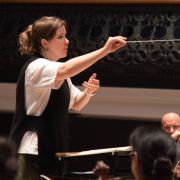
Without a baton, Lazarova scythed her hands to propel the score, drawing a punchy sound from the orchestra from the opening chords of the Allegro appassionato. Mayer develops her material in interesting ways, building to a galloping accelerando which closed the first movement in exhilarating fashion. Shimmering strings and flutes evoked woodland glades in the gentle Adagio – Lazarova imagining a bird fluttering into the canopy – before a raucous Scherzo, complete with earthy Trio featuring drone effects in the lower strings. Dramatic accents punctuated by brass and timpani added heat to the lively Presto finale to close a superb rendition.