‘An immortal work’ is how, in 1910, a delighted Fritz Kreisler described the Violin Concerto just completed for him by Edward Elgar. Although the century that followed its successful premiere saw this simultaneously symphonic, intimate and enigmatic concerto become one of the lesser-performed in the violin repertoire – no doubt on account of the degree of thought, concentration and commitment it requires – all of a sudden it is everywhere now, with each new set of interpreters bringing something new to the table. In short, Kreisler was right.

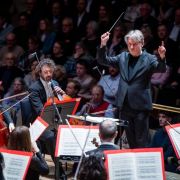
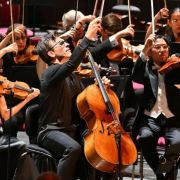
The take on it heard from Christian Tetzlaff on his recent recording with the BBC Philharmonic under John Storgårds is a dramatically intense, sinewy and momentum-filled one. This was what he also gave the Royal Festival Hall on Wednesday evening with the LPO and its Principal Guest Conductor, Karina Canellakis, who herself was soundly on that same page. Even before Tetzlaff entered, there was grippingly clean, athletically forward-pressing, lucid-textured orchestral playing, which in the first movement found a Bach flavour in its dense inner counterpoint, and in the finale, a spiky melodic angularity and harmonic dissonance that was more Second Viennese School than Edwardiana.


It was perfect for Tetzlaff, who himself was visually almost too physical at points – crouching in softer dynamics, even – but compelling with it. The heart-tugging Windflower theme was powerful under his fingers for its directness: vibratoed but not rubatoed. Similarly, intensely personal as the work feels, Tetzlaff didn’t transmit this by almost cocooning himself in a Romantic bubble with it, as some violinists are wont to do; this was instead an outward-facing performance to which the hall responded with enthusiastic applause after every movement, and rapt silence for the cadenza. His encore, the Andante from Bach’s solo Violin Sonata no.2, was played with similar pacy simplicity.
The second half began with the UK Premiere of Dai Fujikura’s Radiance, an LPO co-commission for which the brief was a work echoing Beethoven’s world in some way. Fujikura chose to interpret this by using Beethoven’s musical material simply as a catalyst for his own music and ideas, stretching a recording of a Beethoven symphonic movement (which one, he would not reveal) to around five times its original length, then composing his own music on top of the slow-moving, low-frequency landscape this yielded – but only until it found its direction, at which point he removed the Beethoven entirely and continued alone.

The result is a 10-minute evocation first of emerging light, and then of brightness rising out of pressure and gravity. Hearing it from Canellakis and the LPO, what immediately struck was that, even in its lighter-scored, upper-register beginning, this was no ethereal, searching emergence, but one which had a life-affirming firmness and optimism. Think bright, clean, wide, white-light tonal intensity, with the woodwind so luminous and the strings so fulsome that there was a 3D quality even before tremolo, pizzicato and flutter-tonguing entered the textural mix. Add wide, polytonal harmonies sounding almost like Ives, and Fujikura’s trademark rhythmic dynamism, and its title said it all.


Radiance was equally all over Beethoven’s Symphony no. 5, which Canellakis introduced from the stage as being dedicated to the memory of Swedish conductor Herbert Blomstedt, who had passed away earlier in the day, aged 99. Although its fate-filled, door-knocking motifs were rapped out swift and dark, the light when it came was one which blazed – and over a thrillingly fresh account reprising the Elgar’s lucid-textured springing athleticism and rhythmic bite. It was a sparkling tribute to Blomstedt, and the whole concert to the relationship between Canellakis and the LPO.