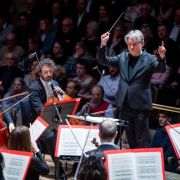
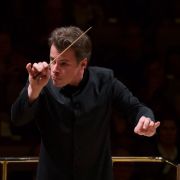
Standing room only in the Arena, barely an empty seat, and no wonder at Tuesday night’s BBC Prom from Sakari Oramo and the BBC Symphony Orchestra. This was a programme worth turning out for: the UK premiere of Mark-Anthony Turnage’s Festen Suite; cellist Guy Johnston as soloist in Britten’s Cello Symphony, completed in 1964 for his great Russian friend Mstislav Rostropovich; and Sibelius’ Second Symphony, which is thoroughly home territory for the BBCSO and its Finnish Chief Conductor.

Festen, for those in need of a reminder, is Turnage’s 2024 opera for The Royal Opera to a libretto by Lee Hall that is based on Thomas Vinternerg’s 1998 film of the same name – which turns a critical spotlight on collective denial and complicity through a plot centred upon the uncovering of historic sexual crime – of which acknowledgement would ruin a group of party guests’ ability to be lavishly wined and dined by its wealthy perpetrator. Critically lauded as it was, Turnage’s score begged to be worked into a concert suite, and you don’t need to know the opera to relish either this new eight-movement suite’s skilfully knitted, panache-filled stylistic eclecticism (new English pastoralism, jagged driving rhythms, jazzy brass smears, big-band swing, Blues laments…) or its tense, emotionally potent trajectory towards a suddenly anodyne, “Nothing to see here, chaps...” morning-after epilogue. From the BBC Symphony, darkly spicy writing such as the Conga felt a little polite and buttoned. More convincing was the folk-breathed fourth movement with its lyrical cello solo, Grandmother’s Song. But how wonderful to have the suite showcased at the Proms, and the applause was appreciative – not least from Turnage himself in his trademark pork-pie hat, on his feet, his clapping hands outstretched towards the stage.


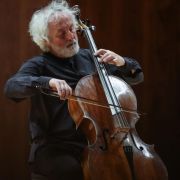
The consequences of moral frailty also overshadow Britten’s eerily brooding Cello Symphony, a terse, four-movement, concerto-meets-symphony debate between cellist and orchestra written in the wake of Britten’s War Requiem and against the backdrop of Soviet artistic repression, its compositional progress hampered by illness on the part of both composer and dedicatee. Darkly rhetorical, and often soft of dynamic, skeletal of texture and occupying the cello’s lower registers, its writing is tailor-made for the supportive Snape Maltings acoustic in which it was premiered, and somewhat less so for the famously unhelpful Royal Albert Hall acoustic, which thus did a lot of swallowing up Johnston’s lyrical take, messing with the balance. Essentially, to sit in the hall was to hear the musicians’ intensity while wondering wistfully how it was sounding to those listening instead to the BBC broadcast. But that’s reason to listen back to the broadcast rather than to not programme it. Plus, Johnston’s encore was movingly wonderful – the coda from Britten’s 1971 Cello Suite no. 3, also for Rostropovich, into which is woven the Russian hymn to the dead. Johnston’s pensive song floating in the hall’s stillness came with added emotional resonance, him having introduced it with the information that, aged 16, he had performed Britten’s Young Person’s Guide to the Orchestra from the cello section of the National Youth Orchestra of Great Britain, under the baton of none other than Rostropovich.


To close on the hall-filling warmth and optimistic song of Sibelius 2 then felt perfect. The orchestra was clearly in its comfort zone, its woodwind and brass particularly luminously gripping. Their climactic hymn of triumph as if through the flames was a stirring one, and rapturously received.
Was it an evening of wall-to-wall satisfaction? Not quite. But was the Proms magic there? Most definitely.