Erich Wolfgang Korngold first came to California from Vienna in 1934. A decade later, Michael Tilson Thomas was born in Hollywood to a family with deep entertainment industry ties. In these environs, one man would essentially invent the film score genre, while the other would lay the groundwork for a consequential career as a conductor, composer and cultural ambassador for classical music around the world. The Los Angeles Philharmonic – their hometown band, after a fashion – honored them both this weekend, dedicating the first half of their program to a pair of Angelenos, one by birth and one by naturalization, whose talents could not be easily categorized.

Of course, there was a bittersweet element to the concert, conducted by Andrés Orozco-Estrada. After living with glioblastoma for five years and continuing to conduct past his 80th birthday, Tilson Thomas died on 22nd April. His Agnegram, written in honor of a San Francisco Symphony patron during his tenure as that orchestra’s Music Director, thus became a tribute to his legacy. Orozco-Estrada dedicated the concert to Tilson Thomas, who served as the LA Phil’s Principal Guest Conductor from 1981-85.


The piece bore the restless hallmarks of MTT’s musical omnivorism, borrowing from Americana, Tin Pan Alley, Broadway and jazz to create a restless portrait of a vibrant soul. Quotes from Tchaikovsky and Verdi jumped into the ear, but with puckish, bustling transportation. The composer cast the work as a march, and the muscular introductory brass fanfares, underlaid by percussion, straightened the spine.
The music seemed to describe the man who wrote it as much as its subject. Lyricism danced with humor, European charm melted into American populism. Orozco-Estrada created an environment of controlled chaos, supporting detailed solo playing before letting things rip. Tilson Thomas might have employed the Bachian trick of spelling the dedicatee’s name, Agnes, in pitches, but it was his immortal specter all over the work.
Korngold composed his Violin Concerto in Los Angeles, an attempt at maintaining a link to his European classical roots. Despite this, the work brims with the influence of his second career: even the passages not lifted directly from his film scores sound like movie music. You could imagine a romantic scene playing out amid the lush strings of the second movement, or picture the wide open plains of the Western genre in the bright horns and zesty woodwinds of the finale.
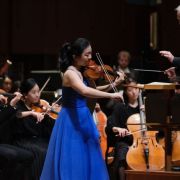
Orozco-Estrada drew a hushed shimmer to complement soloist Maria Dueñas in the first movement’s cadenza, and highlighted Korngold’s use of unusual instruments like the celesta, played with penetrating eeriness by Joanne Pierce Martin. The swashbuckling energy of the final bars proved irresistible. At its best, the performance seemed to laud the hometown industry.


Dueñas brought elegance and technical mastery to a piece where the soloist rarely gets a moment to breathe. Her performance lacked the warm, enveloping tone needed to underline Korngold’s devotion to a lost Romantic worldview amid the rise of Modernism. The strings seemed too often to absorb her in the second movement. A greater sense of assertiveness would have been welcome. She proved more persuasive in her encore, her own arrangement of Granada for herself and harpist Emmanuel Ceysson, full of style and tang.
The concert ended with a highly detailed account of Dvořák’s Symphony no. 7 in D minor. Orozco-Estrada ratcheted up the tension in the introduction of the Allegro maestoso to a crushing breaking point, then changed the mood on a dime for the lively second theme. The second movement was soft and contemplative, Denis Bouriakov’s charming flute solo sailing above the fray. The calm gave way to the exultant dancing character of the Scherzo, where the normally plush LA Phil forces convincingly mimicked a country band. While it feels inappropriate to describe a work rooted in nationalistic fervor as “regal”, I can think of no better adjective for the finale, which concluded the proceedings with a sense of soaring majesty.