Sheen, shimmer and might... plus a star soloist. If there was a theme to the London Symphony Orchestra’s concert on Thursday night with its Chief Conductor Sir Antonio Pappano, then it was that of mass appeal. Erich Korngold wrote his Violin Concerto in D major in 1945 for arguably the most thrilling virtuoso of the day, Jascha Heifetz (he of the whippet-like speeds and white-hot tonal intensity), and its score exudes the influence of the 15 film soundtracks he’d composed for Hollywood by this point, since fleeing the 1937 Nazi annexation of his native Austria. Shostakovich’s Fifth Symphony of 1937, composed when the denunciations and disappearances of Stalin’s Great Terror were in full swing, was the purposefully low-dissonance, high-octane crowd-pleaser with which he successfully rehabilitated himself with the Soviet State after its threatening 1936 condemnation of his opera Lady Macbeth of Mtsensk as a bourgeois “muddle instead of music”.


Before we could get to those two, though, the overture slot went to Imogen Holst’s tone poem, Persephone. Composed in 1929 while Holst (daughter of Gustav) was a student at London’s Royal College of Music, it loosely depicts the myth of Persephone, Greek goddess of Spring, whose being tricked into becoming Hades’ Queen of the Underworld for three months of the year was said to have caused winter. This was Holst’s only major orchestral piece, and not published after its first performance at the College. Neither did she revive it over her subsequent successful career as a composer of more intimate-sized works, and as Benjamin Britten’s composition assistant and Aldeburgh Festival co-administrator. Listening to the LSO’s warmly shimmering realisation of its stylistic mash-up of lushly-textured French Impressionism (think Ravel’s Daphnis et Chloé) and English Pastoralism – with a slight architectural lumpiness that not even Pappano’s superbly taut shaping could entirely mask – it’s just possible that this was because Holst herself viewed it as a student piece that didn’t merit resurrection. The applause which followed its undeniably impressive final bang was politely appreciative; possibly also a little bemused.
Still, no caveats to the enjoyment of what came next. Vilde Frang as soloist for the Korngold bestowed a further sprinkling of stardust over its superbly crafted, more cinematic brand of shimmer. As for the account itself, this was a beautifully Romantic-leaning, long-drawn, floating dream world full of bold freedom in the phrasing; indeed even the concerto’s vivacious, rhythmic finale, replete with formidable high-speed virtuosics for the soloist, saw Frang and Pappano leaning deep into its opportunities for gentler, more time-suspended expression; and always, always, with ardently vibrato’d Frang the riveting focal point as she gave it – to use a hackneyed expression that nevertheless is the truth – body and soul. There was no encore; as a gentleman in the seat behind me remarked to his companion, “She’s done enough.”


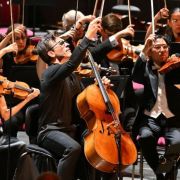
At his Fifth Symphony’s Moscow premiere, a relieved Shostakovich chose to describe it with words borrowed from a critic – that it was “the practical creative answer of a Soviet answer to just criticism”. However in 1979 Solomon Volkov’s book, Testament – purportedly memoirs gathered from a sick and weary Shostakovich before his death in 1975 – had him explaining it very differently: “It’s as if someone were beating you with a stick and saying, ‘Your business is rejoicing, your business is rejoicing’”. In the Barbican Hall, Pappano and the LSO had those two ideas walking grippingly side by side. Memorable – unforgettable – moments in this dramatic, grippingly ambiguous account included their transcendentally serene, melting Largo conclusion and a final climax of roof-raising, spine-tingling fevered brilliance and brightness. Persephone’s heaven and hell hadn't quite convinced. Shostakovich’s, though, was electrifying.