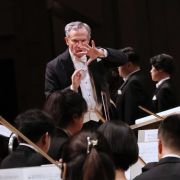
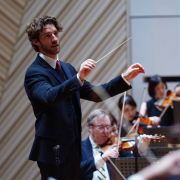
Pairing the music of Verdi and Wagner – two titans of the operatic world born in the same year – in a single orchestral concert is rarer than you think, but Daniele Rustioni’s concert with the Tokyo Metropolitan Symphony Orchestra consisted of nothing but Verdi and Wagner: four Verdi works in the first half followed by four Wagner in the second. No singers: just orchestral highlights from his music dramas.

Held ahead of Rustioni assuming the post of Guest Principal Conductor of TMSO from April, it was a chance for the audience to get a taste of what to expect from this new partnership. Considering his credentials as opera conductor – in Lyon, Munich and latterly New York – it wasn’t surprising that he chose a programme of operatic fare, but he is generally more known for his expertise in Italian repertoire, so I found the choice of Wagner intriguing. Perhaps this is the direction he wants to expand in the future.


Rustioni began at full throttle with the dramatic overture to La forza del destino. It’s certainly an effective concert opener that begins with ominous chords and the “destiny” theme, followed by a quick whirl through all the gorgeous melodies of the opera. Rustioni led with dynamism and urgency, creating the drama directly without resorting to too many tempo fluctuations. The brass section of the TMSO, especially the trombones and cimbasso, were excellent, producing a glorious sonority that resonated around the hall.
The overture was followed by the ballet music for Macbeth and Otello, which Verdi added for their respective Paris premieres, and are often omitted in the productions of the Italian versions. In particular, Rustioni conjured up the exotic charm of the Otello ballet music, which begins with an oriental melody reminiscent of Aida’s Nile scene opening music. The Verdi half concluded with the overture to I vespri siciliani, an earlier work written in the grand opera style, containing alternately lyrical and fiery melodies. Rustioni brought out energetic and crisp playing from the orchestra, and we were able to revel in the details of Verdi’s often busy string writing which tends to get lost in the depth of the pit. Applause also to the many touching woodwind solos that vividly conjured the scenes of the opera.
The Wagner half was placed in chronological order, starting with the overture to Rienzi, which was also the earliest work in this programme. Listening side by side to Verdi’s I vespri overture, one could hear that at this point Wagner was not that far apart from his Italian colleague, with influences from Italian and grand opera traditions. But by Tannhäuser, Wagner had carved his own grand, solemn, imposing orchestral sonority and Rustioni was clearly relishing this music, often singing along quite loudly in order to inspire the orchestra. He took it at an energetic pace, without excessive reverence, unfolding the music organically and lyrically. On the other hand, in the Lohengrin Act 1 Prelude, one missed the spaciousness and the sense of mystery inherent in the music. The Meistersinger Prelude was also played with brilliance and grandeur and sonically it was satisfying, with the brass section excelling again, but here Rustioni lacked the long sweep of the music and peaked too soon so that they couldn’t climb any further in the final climax.


Although TMSO is not an opera orchestra, in recent years, under the music directorship of Kazushi Ono, it has regularly played in the opera pit of the New National Theatre Tokyo (most recently in Wozzeck). The players responded keenly to Rustioni in this operatic programme. I certainly look forward to how the partnership will develop in the coming years.