Even before a single note was played, the sheer star power of Anne-Sophie Mutter made itself felt: the queue for the lifts into the hall stretched far longer than usual. That sense of expectation framed an evening in which the London Philharmonic Orchestra demonstrated an impressive dual capacity: to mould itself entirely around a dominant solo personality, and later to step forward with unapologetic orchestral self-confidence.

The concert opened with Jean Sibelius’s Pohjola’s Daughter. Karina Canellakis shaped the work with patient breadth, allowing its dark orchestral palette to emerge gradually. Low strings and woodwinds evoked a stark northern landscape, while brass climaxes rose with controlled intensity. It was an interpretation that emphasised atmosphere and narrative pacing over overt drama, preparing the stage for the highly individual presence that followed.


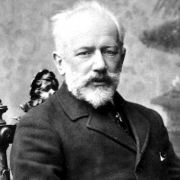
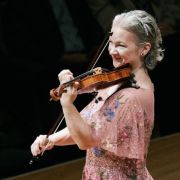
The ensuing Tchaikovsky Violin Concerto was unmistakably soloist-led, above all in interpretative conception. Mutter asserted complete artistic authority, embodying every hallmark of leadership: commanding stage presence, unshakeable poise and a tonal identity instantly recognisable. Her approach was steeped in a grand tradition, with generous vibrato, a consistently warm and rounded sound, her phrasing less concerned with razor-sharp contour than with saturated lyricism. At moments, her timbre assumed a slightly nasal focus, part of a projection style that privileges expressive intensity and vocal immediacy over surface polish.
The LPO adapted to her aesthetic with extraordinary sensitivity. Like a seasoned opera orchestra accompanying a prima donna, they followed her expansive rubato with care and precision. Mutter’s phrasing at times stretched musical time to its elastic limits, yet the orchestra ensured that the broader symphonic flow never faltered. Canellakis’ role was more that of a refined mediator – safeguarding balance, transparency and structural coherence while allowing the soloist’s vision to unfold freely.
The warmth of this collaboration was distilled in the encore: a brief, sincere miniature by André Previn, offered as an intimate afterthought; tender, unpretentious, and beautifully shaped.

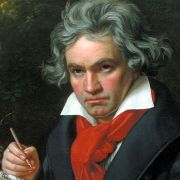
After the interval, the dynamic shifted decisively. In Beethoven’s Seventh Symphony, the orchestra finally seemed able to claim the stage for itself. If the first movement’s exposition retained a residual sense of restraint – an echo, perhaps, of the concerto’s deference – the development section opened into a freer, more abundant sound world. Here the players’ rhythmic vitality and tonal depth fully ignited.


The second movement demonstrated exceptional control of long-range dynamics: The Allegretto’s ostinato emerged from a true pianissimo, crescendos terraced with architectural patience. Canellakis revealed a rare sense of reserve, holding back cumulative force until it truly mattered. By the Scherzo and Finale, orchestra and conductor alike appeared liberated. Two movements were tightly linked, propelled by infectious rhythmic drive. Canellakis allowed them space to revel in Beethoven’s kinetic energy while maintaining a firm grasp of the symphony’s long arc. What electrified was the orchestra’s palpable musical self-ignition, an impression of players thinking, reacting and driving the momentum in real time.
Tonight the LPO proved fully capable of inhabiting the authoritative, tradition-steeped sound world shaped by star soloist, while in Beethoven, embracing a more contemporary orchestral ethos of transparency, rhythmic buoyancy, and collective spontaneity.
This concert was promoted by DK Deutsche Klassik