The Australian Ballet’s Nutcracker Act 2 and Other Works is a quadruple bill, with something for everyone, whether a classical ballet devotee, a lover of fairyland fantasy, or an aficionado of contemporary dance. Performed by a touring group of junior company members, plus students from The Australian Ballet School, the program is just over midway through its regional tour, which covers regional cities, as well as the capitals Adelaide and Darwin.

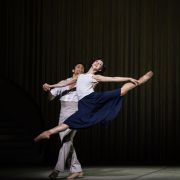
The opener is the classical gala piece Tchaikovsky Pas de Deux, choreographed by George Balanchine. Even in the smaller Dunstan Playhouse theatre (capacity 590), the two dancers were very exposed on a bare stage, embellished only with a projected background of pale pink grading to blue.
Artistic Director of the company, David Hallberg, spoke briefly to the audience before curtain-up, and reminded us to ‘bring it’ when showing our appreciation. With only two dancers, recorded music and minimal design, it must be hard to fire audience enthusiasm. Maybe this pas de deux would be better placed just before interval, after two other works for bigger groups. However, dancers Hannah Sergi (Corps de Ballet) and Harrison Bradley (Coryphée) brought it off, Sergi fleet and delicate in the demanding Balanchine choreography, and Bradley partnering well and projecting power in his solos.


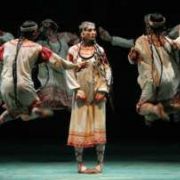
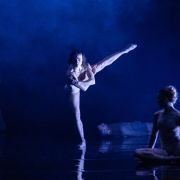
The second work was We Dance by Sandra Parker. The gravitas of this contemporary piece contrasted with the opening pas de deux. To recorded music with echoing chimes and a hypnotic pulse (composer Laurence Harvey), two couples move in elegant, ritualistic patterns, looking like performers in Ancient Greece. The women and men all wear softly draping, wide culottes with sleeveless tops, each in a different colour: beige, black, light blue and dark blue (designer Emily Collett). Light brown socks complete the look. The background is dark, with soft pools of light around the dancers (lighting design by Bosco Shaw). Syncopation drives the movement, with dancers pausing for varying intervals after moving on a strong beat. The four extend their arms in poses expressing yearning, and create some beautiful lines.

The varying syncopation must be tricky to maintain and I imagine the dancers are doing a lot of counting. Occasionally, movement that appeared intended to be in unison was a bit ragged. However, I would love to see We Dance again. Thank you, Sandra Parker, and dancers Larissa Kiyoto-Ward, Yaru Xu, Bryce Latham and Hugo Dumapit.
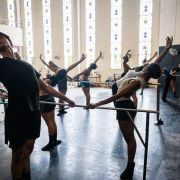
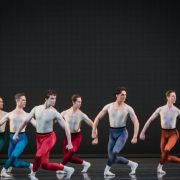
Stephanie Lake’s Chrysalis broke the calm created by We Dance. Chrysalis was commissioned for students of The Australian Ballet School, and expresses their energy and vitality, as does the electronic music by Robin Fox. The title is apt for these emerging dancers. Lake creates interesting shapes and movement effects for the group. They crouch and waddle like ducks, run on the spot, perform martial-arts-like moves, and also clap and use their voices, at one point clustering together in different positions and yelling, shrieking, groaning, and shouting.

The 12 dancers are dressed in body suits ending above the knee in bold, dark-red stripes or patterned in brown, teamed with dark-red socks (designer Kate Davis). The colours suit the dynamism of the work. The lighting (again by Bosco Shaw) surrounds the dancers with pools of light on a dim stage.
After the interval comes the focal work of the program: Nutcracker Act 2, choreographed by Paul Knobloch after Marius Petipa. This is the part of the ballet set in the Kingdom of Sweets, with many opportunities for different dancers. The Sugar Plum Fairy (Larissa Kiyoto-Ward) and her Prince (Hugo Dumapit) shone in their grand pas de deux. Kiyoto-Ward sparkled, with precise footwork and floating balances, and maintaining the upward momentum of lifts with lyrical effect.


Spanish, Arabian and Russian dances are included in this version of Nutcracker, as well as the Mirlitons/Candy Canes. After a fiery Spanish duo, the sinuous Arabian couple coiled and stretched impressively. A male soloist danced the Russian trepak with impish verve. And the Candy Canes, two female dancers performed a less spectacular duet.

The roles of Clara and the Nutcracker were ably filled by Sara Andrlon and Jeremy Hargreaves, who have little to do. Similarly with Bryce Latham as Drosselmeyer, who acted as MC introducing the different dances, swirling his black cape with glittering epaulettes. Yaru Xu was a delicate, flower-like Floral Fairy.
The traditional costumes (designers Kristian Fredrikson, Hugh Colman, Hugh Liang and Louisa Fitzgerald) display lots of tulle, ornaments and colours. Lighting (by Paul Lim, recreated by David Jenkins) and set design (by Kat Chan) suit the fairytale theme, with a projected backdrop that looks like rainbow fairy-floss. Tchaikovsky’s music bewitches, despite not being live (Orchestra Victoria, conductor Jonathan Lo).
Artistic Director David Hallberg’s says in the printed program: ‘Sharing live performance, inspiring young dancers, and welcoming new audiences – that’s what makes touring so special’. The audience applauded rapturously at this first night performance, evidence that they also found it special.