Imagine it is mid-December, 1980. Ronald Reagan has just become the 40th President of the United States and, according to music charts, you are probably listening to Woman in Love by Barbra Streisand or – for an unfortunate turn of events – to John Lennon. At the same time, in what was then West Berlin, a new production of Donizetti’s Lucia di Lammermoor is premiering at the Deutsche Oper at the hands of Italian director, Filippo Sanjust. What you perhaps couldn’t have anticipated back then is that the production will have enough legs to ensure it a decades-long lifetime, with hundreds of performances leading to this umpteenth revival in 2026. Together with old acquaintances, however, new faces were also to be seen for this latest run: the theatre's new Intendant Aviel Cahn, who introduced the evening, and this season’s Principal Guest Conductor, Michele Spotti.


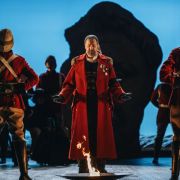
Unsurprisingly for a staging that has been around for more than 40 years, a lot has been said about Sanjust’s Lucia – admittedly, there was not much to say to begin with. Already at its inception, the production seemed to play with its own traditionalism, counting on the charm of painted backdrops with strong perspective angles. Careful colour combinations, heavy on the contrast between desaturated browns and bright blues and oranges, provide a beautiful pictorial effect, most likely intentional in its stylistic inconsistencies. Costumes reminiscent of historical Scottish fashion complete a picture that is undeniably evocative but hardly adds any meaning other than underlining the distance of the past – both of Donizetti and of his source, Sir Walter Scott.
For the singers, this translated into unimaginative stage movement which recalled the clumsiness of recitals rather than a full theatrical production. Awkward pauses during scene changes, with the curtain closed and the orchestra silent, didn’t help. If the goal was to appeal to the nostalgic feeling of ‘opera as it once was’, one might have left the theatre with renewed hope that our own times may have something better to offer.
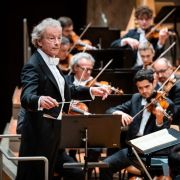
Spotti’s debut in the pit also produced mixed results. On the one hand, he leaned into a misty, smooth sound, which proved to be a good match for both score and staging. The strings, in particular, granted a reliable timbral foundation, soft and pleasantly lyrical. On the other hand, rhythmic imprecisions between different sections of the orchestra, or between orchestra and chorus, impacted the outcome of a few scenes, especially at the beginning. Once Spotti got into the groove, the ensemble proceeded at a good pace. Instrumental highlights – the harp in Lucia’s cavatina, the flute in the Mad Scene – ranged from serviceable to captivating. Better alignment between conductor and the main trio of singers brought to mind a traditional scuola italiana approach to conducting, which will be interesting to follow during Spotti’s time in Berlin.


Nina Minasyan’s resume features some touchstones of the soprano leggero repertoire, and her Lucia carries their mark. Where Minasyan sounded most at ease were sections which allowed for a clean, undisturbed display of her impeccable high register. Nonetheless, what is necessary for a memorable Lucia isn’t also sufficient: a part that so heavily relies on coloratura risks sounding like an exercise in cadenzas when not backed by interpretative nuance. Minasyan’s performance was well-sung but ultimately weighed down by generic, somewhat rushed phrasing, which filed Lucia into a folder of indistinct helpless Romantic operatic heroines.
Even for a role originated by Gilbert Duprez, Galeano Salas’ Edgardo was particularly extrovert. Thanks to a naturally large and well-projected tenor, Salas filled the hall during his arias and made himself – welcomely – heard in duets and concertati. Stable intonation through the registers and precision even during moments of confusion between pit and stage earned him a good success.
As Enrico, Mattia Olivieri managed to achieve the near impossible: making his character vaguely likeable. Olivieri clearly felt at ease on stage, the most convincing actor among the main trio. On top of that, his clear, agile baritone filled the requirements of the part, animating arias and recitatives with a flair for the theatrical. Lastly, there is only to hope that the Deutsche Oper’s Chorus gets back on track – and in time! – for the next performances.