

The opening night of LA Opera’s revival of Francesca Zambello’s 2018 retro-camp Candide celebrated Voltaire’s 332nd birthday with a splashy pat on the half-buttocks. Stage machinery gobbled the music, costumes, singers and dancers. It was a synthesis of Time Bandits, The Adventures of Baron Munchausen and a Las Vegas revue, but with a much better score.

For anyone who grew up with 55 minutes of the original cast recording, when Candide was still only an operetta – devastatingly cool, dangerously sexy and only marginally politically dangerous – the two hours plus it took at the Dorothy Chandler Pavillion felt bloated and unnecessary, if not disconnected from Lillian Hellman’s original wish to throw down the gauntlet to McCarthy’s fascists (or fascists in general). Zambello’s programme note makes the connection explicit: in a hyperconnected world, she asks what garden each of us will cultivate in the face of human suffering, a much more serious proposition than the work that greeted me when I fell in love with its original version. I am still not sure that Candide is entirely comfortable when asked to be anything more exalted than operetta.


Curiously enough, the music, when it was not downright genius in the famous numbers, often sounded as though it had borrowed whole snatches from Gilbert and Sullivan. But Bernstein heard further back: he spoke at the time of being haunted by “the ghosts of Hérold and Auber”, whose operas helped make Pirates of Penzance and Mikado possible.

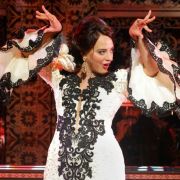
Everything here was relentlessly over the top, bleak and bawdy standing in for sexy and sensual. It took Jimmy Durante’s warning to heart: “If you don’t sing loud enough, da people won’t hear da music!” Meghan Picerno’s Cunegonde sang loud enough, a confrontational conception of fearless commitment, brilliantly executed. In “Glitter and Be Gay” she prowled the stage, mixed charm and camp most promiscuously, and took the final notes two or three octaves higher, somewhere beyond Mars. No one will ever forget it. Duke Kim’s Candide also sang loud enough, passionately and intelligently, but stressed the character’s pluck at the expense of his guileless, pre-sexual vulnerability. Kristen Choi’s Paquette was a delightful Despina type, but not quite a wench.
Scott Bakula played Dr Pangloss affectionately, a lesser French Prospero. In a pleasant, not too obtrusively miked voice, he sang “The Best of All Possible Worlds” clearly and did yeoman work holding together the long stretches of narration in which he was stranded more or less alone. As the evening proceeded, however, through no fault of his own, he became increasingly irrelevant to the production’s commotion.


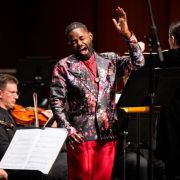
The mid-century Zeitgeist was surreal. Patti LuPone thrilled the audience by flaunting her Old Lady’s one remaining buttock with broad antics and easy guffaws à la Carol Burnett. Bernard Holcomb’s Governor filled the hall with a big voice and a Ricky Ricardo accent. Mario Manzo’s foppish Maximilian made a brave attempt at a full Dom DeLuise, while Pangloss’s comic fumbling with German place names recalled Sid Caesar’s brilliant foreign-film parodies from his Show of Shows which had ruled the airwaves only a few years before Candide opened on Broadway.
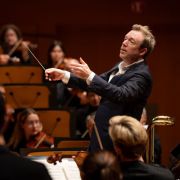
With LA Opera’s new Music Director Domingo Hindoyan off conducting in Liverpool and Vienna, resident conductor Lina González-Granados had so much going on above her that I gave up trying to evaluate much of what she and her orchestra were doing. But it was alll there: brassy glitter, lilting waltz and all the moments when Bernstein clears space for feeling.

Ironically, the original Candide ran for only 73 performances, and Caesar's Show of Shows was displaced by The Lawrence Welk Show. Of Welk – the genial bandstand director whose ‘Champagne music’ became a symbol of television's increasingly lowbrow musical taste – Caesar would merely shrug: “He was funnier.”