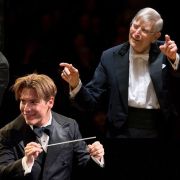
Daniel Harding made his first appearance on the Disney Hall podium since his appointment as the Los Angeles Philharmonic’s next Music Director, beginning next season, in a program of Betsy Jolas, Leonard Bernstein and Johannes Brahms. Succeeding Gustavo Dudamel and Esa-Pekka Salonen – two highly charismatic musical and public celebrities – Harding offered a quietly authoritative presence, one that let the music do the talking.

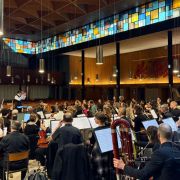
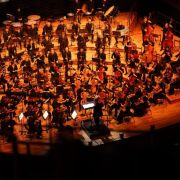
There was a newfound, thrilling unanimity of attack in the strings: a real collective voice led by the Phil’s new concertmaster, Vineta Sareika of the Berliner Philharmoniker. The violins and violas were more focused and flexible; the lower strings had greater depth and weight without sacrificing their ability to croon. The woodwinds played all night with unusual style and color. The brass, too, seemed willing to play wonderfully softly – or at least mezzo forte – as well as wonderfully loudly.


Harding introduced centenarian Betsy Jolas’s Latest with the disarming manner of a British talk-show host, as if he were interviewing the piece itself, putting the audience on their toes for music composed at the tender age of 95. Jolas calls it a “cabinet of curiosities,” and from the first bars one wanted to have the score along to see how she created such extraordinary sounds.
Hints of Ravel and Mahler only begin to describe Jolas’s kaleidoscopic shifts of perspective: spectral colors, unexpected instrumental combinations and a theatrical imagination creating what the Phil’s former director of publications John Henken, in the program book, calls “a percussion-rich fantasy”. Most fascinating are its “free zones”, passages in which conductor and players engage in a partly improvised dialogue.
From the opening, the Philharmonic played as if this strange, ingenious music had been written expressly for it, although it was jointly commissioned by the Orchestre de Paris, Bavarian Radio Symphony, San Francisco Symphony and Royal Concertgebouw. Harding’s gift was to create space. He did not over-control the musical events, but allowed them to emerge, collide and vanish with their own inner logic.

Jolas fans need not worry that she has slowed down. Latest is far from her latest work: since then, she has written a small piece for solo clarinet, a larger one for soprano and orchestra, Ces belles années, and Paris: A Poem, for narrator and piano quartet after Hope Mirrlees, composed this year.
Bernstein’s Symphony no. 1, Jeremiah raised inevitable reflections on our own follies, and moments of deep sadness and regret. Avery Amereau sang with the gravity of sacrifice and the richness of consolation. Afterwards, Esa-Pekka Salonen, seated behind me, offered a succinct verdict: “Good!” It was good and deeply moving, and the full house warmly applauded.


After intermission in Brahms’ Second Piano Concerto, the sheer poetry that was Andrew Bain’s opening horn call instantly caught the silence of the hall, seeming even to mute Leif Ove Andsnes’ response. Harding and the orchestra then swept into the opening tutti with crisp energy and physical beauty, rendered with audiophile clarity, texture and dynamic range. With Andsnes maintaining his inward focus, they traversed the music as if inhabiting two different musical universes. Overall, they bypassed its conventional breadth, weight and ardor for something sometimes magical – especially in the slow movement – and at other times more observational. The phrasing was intelligent and the accompaniment attentive, but the performance did not quite find the unified, deep current of feeling that makes a performance of this concerto special. The thunderous applause at the end suggested that few shared that reservation.