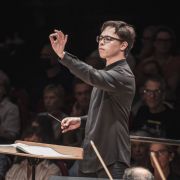
The second week of Elim Chan’s West Coast visit offered a reminder of the remarkable roster of Music Directors California will have in place next season, including Daniel Harding in Los Angeles, Rafael Payare in San Diego, Alexander Shelley in Costa Mesa and Chan herself in San Francisco. The state has an astonishing orchestral density: of the approximately 2,218 professional, community and youth orchestras counted nationwide, 283 are in California and 98 in the Los Angeles area alone.

Alas, the gods of programming decreed that Chan should face three challenges apposite to the point: convincing the LA Philharmonic to imagine a French Impressionist haze; managing Samuel Adams’ enormous new Violin Concerto; and energising a standard-issue Stravinsky ballet score. She tried, they tried but it was Karen Gomyo who totally scored in Adams’ Violin Concerto no. 2, “The Wheel”, receiving its world premiere.


In its half hour, the concerto seemed to follow the composer’s detailed programme note: large orchestral shapes turned in space, gathering around Gomyo’s heroic figure. Adams is plainly in love with the violin, though he spins out tunes so long that they sometimes soar out of sight. The first movement, Fast, began with an introduction to the variety of orchestral possibilities ahead: muted strings, arpeggios and instrumental colours repeatedly announced themselves, while the violin sent up yearning gestures that seemed to seek harmonic arrival. The second, Heavy, set the soloist darting around great, galumphing orchestral masses. Whatever the circumstances, Gomyo continued to play on, even when her sound was swamped by the full orchestral strings.
The slow passacaglia, Very calm, suspended, featured a repeated line that accumulated a genuine atmosphere of expectation, while a solo trombone, clanking percussion and the violin’s suspended line made a compelling landscape. The finale, Fast again, accelerated relentlessly, propelling the soloist towards a sequence of monumental swoops. If its elaborate machinery sometimes seemed to turn for its own sake, the overall effect was undeniably theatrical – a point the audience, which greeted the work with wild enthusiasm, clearly understood.


After the flute in Debussy’s Prélude à l’après-midi d’un faune, which opened the concert, suggested repose more than sultry heat, Chan drew a clear account from the orchestra, although the texture never managed a wholly seductive French Impressionist shimmer. Kaylet Torrez-Barros’ solo horn was exquisite.
After the interval, Chan hot-wired the orchestra in Stravinsky’s 1947 revision of Petrushka with a jolt of electric energy. As the performance proceeded, however, the phrasing allowed few breaths and some of the episode-to-episode transitions felt pedestrian. The larger arcs remained undernourished and the final great tune did not gather the sweep that puts the finishing touches on Stravinsky’s carnival antics.