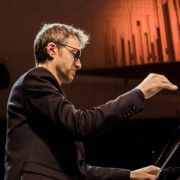
With a capacity of 2,400, the Grande Salle Pierre Boulez at the Philharmonie de Paris isn’t exactly a typical chamber music venue. But then, last night’s concert wasn’t exactly a typical recital, with two of France’s most beloved chamber musicians, Jean-Guihen Queyras and Alexandre Tharaud, celebrating 30 years of performing as a cello-and-piano duo. The hall was packed to the rafters.

The programme was an excursion into various corners of the duo’s repertoire over their time together, including mostly music from France and Austria ranging in time from the renaissance viol music of Marin Marais to the modernism of Alban Berg, with a couple of movements of a Britten sonata added for something outside the usual box. The first half of the concert consisted of two full works, the second a series of shorter pieces and excerpts. The precision and musicianship was of the finest throughout, but while the outcome was unadulterated delight for the French repertoire, when it came to the Austrian music, the older works fared better than the newer.
The opening piece spanned the ages in itself: Francis Poulenc’s Suite française, written in 1935 but drawing on the 16th-century music of Claude Gervaise. The vivacious Bransles and Sicillienne, the slow languorous Pavane with its medieval cadences, the Complainte with Queyras giving the most daring of pianissimi: all transported us directly back to a bygone world of courtly dances – but laced with Poulenc’s daring harmonies and snatches of modernism. Notable throughout was the crispness of Tharaud’s playing, hitting keys with great attack, but not allowing the notes to bloom into richness. The effect created was of sparkle and glitter.
The ensuing Brahms was balm for a wearied soul: a richer tone from Queyras, whose cello can sound truly wonderful in its lowest register, a sound I wished he had used more often than he did. In the long-breathed cantabile of the second movement, Queyras played with a lush tone and great delicacy to give a nostalgic feel. But that elegance served the third movement Allegro less well, feeling bland and lacking in forward momentum.

Queyras’ arrangement of Berg’s Four pieces for clarinet and piano failed to convince me that he had overcome the widely different sonorities of the two instruments: there were plenty of interesting sounds but the overall effect felt inconsequential. But morphing directly into the slow movement of Schubert’s Arpeggione Sonata brought us back to that sense of soothing beauty to at which the cello excels. The opening and closing movements of Britten’s Cello Sonata in C major, provided a notable contrast, containing the most violent music of the concert interspersed with periods of reflection,. These were well suited to Tharaud’s crispness and attack, with Queyras demonstrating some impressive ricochet bowing skills.
The glory was once again the French music: highlights were a Marin Marais fragment proving that you don’t have to be lush and Romantic to tug at the heartstrings, and the Fauré Sicillienne proving that you can combine joie de vivre with elegance. A set of three Brahms Hungarian Dances left me wanting, I’m sad to say: I’ve had more thrills in these works from the average Budapest restaurant band.
After a pause for Champagne to be brought on stage and handed out to each other and a few select members of the audience, a more successful Austrian piece as a second encore: a Piatigorsky arrangement of Haydn, with the two musicians finally getting to let their hair down – something that one sensed didn’t come easily to these very serious and focused artists.