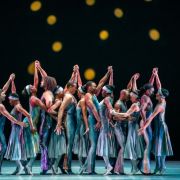
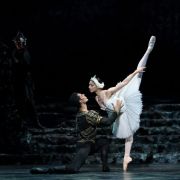
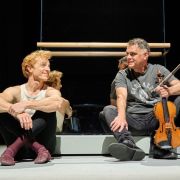
“This show started in a shed in East London – a shed with a tin roof, that fitted 250 people in it. Now it’s been to Romania with 3000 people watching!” Former Scottish Ballet soloist Jamiel Devernay-Laurence is talking to me by video call from a hotel in Edinburgh having just finished teaching a class. His Ballet Nights is appearing for a week of shows at The Fringe and he tells me rather excitedly that the performance the night before had prompted a five star review from a member of the audience, a first. “We like firsts at Ballet Nights,” he grins.

As Devernay-Laurence approaches three years since the start of the company I want to take him back to the beginning. “I think I'm quite an instinctual person who discovers the world as it comes at me. Covid was obviously quite a moment for everybody, but I don’t think even my closest co-workers realised the eventual impact.” He looks a bit sad momentarily before telling me, “I was very sick, not okay for weeks.” Then he reminds me of an idea that had hatched during that time when he started a fund for freelance dancers (Fund Freelance Dance).
“There were all these wonderful dancers who weren’t in companies but who weren’t catered for by the government and I wondered if the public would like to help.” Devernay-Laurence raised nearly £20,000 on that endeavour. “At that time, I would still be calling myself a choreographer,” he continues. “Part of me wanted to make the stuff as well as do it and organise it. What I accidentally stumbled upon was that there was no one who was going to support me from the usual space. There was no government funding for my ideas, no grants and so I found another way to fund what I believed should be happening in the world of dance.”

“All of these things began life on a spreadsheet,” he tells me, “which doesn't sound very glamorous, but genuinely, a lot of my productions and ideas were led on a budget. And for me, numbers really speak to you.” He claims you can find ways to do things that seemed impossible before. He ran the first Ballet Nights independently with his own money. “£7000 was the total cost of the show. And of course at that time in 2021, all the dancers wanted to be back on stage, and so it wasn’t a big leap.”


After the first show he realised that the format had worked but he confesses that he also felt “deep frustration, deep anguish”. The audience gave it a standing ovation but, “I knew I needed an investor to build cash flow and a model that I could then turn into a business. It’s just moving forward in the way that the puzzle, the labyrinth, allows you to.”

A year passed of numerous adventures, Devernay-Laurence reached a low in 2023 because he hadn’t made the Arts Council method work. “I wasn’t finding the level of funding I was looking for from the alternative shows I was doing. Everybody thought I was crazy!” he explains. “They said, ‘Why don’t you put an application in?’ And I thought, why would I waste my time trying to get an application where I have to fit what’s being asked for when I can go to the product market fit and say, ‘Hey, you make construction helmets. I choreograph dancers who tumble out of windows. We should work together’.”
By chance, he tells me, he was invited to dinner, “by the type of invested individuals who love dance, who have given to many organisations in the past, but were left unsatisfied in the area of what’s next. So when you ask a choreographer that you funded to make a work, and maybe that work’s been good, maybe it’s not – what happens now? And often the answer is, I don’t know. And of course, people in business who happen to have the money to fund these endeavours, they know about business plans. They asked, ‘What’s next for this Ballet Nights brand?’.”

Devernay-Laurence tells me that he can see it as a TV show, as a touring show, at stadium level and what they’re doing now at The Edinburgh Fringe. “From that dinner, I had the funding to do the first autumn season of Ballet Nights in 2023, so I connected the dots,” he says. “Really, I put together people that are almost talking to each other, but don’t quite listen to each other. Dance isn’t doing a lot of listening to those people, it’s doing a lot of listening to itself.”
I’m curious to know if this was always the plan. “I’m good at responding to the reality in front of me, and it’s bleak,” he says. “I think there are these dance companies that have forgotten that they’re not even an eighth as old as some of the banks and other businesses out there and I think dance needs to find a way to fill theatres night after night.”

Devernay-Laurence has been instrumental in helping to put young choreographers such as BlacBrik and James Pett and Travis Clausen-Knight (PCK Dance) on the map and I wanted to know how crucial his involvement has been to their journey. He tells me,“BlacBrik actually had a full-length show in their minds ready to go, but younger choreographers today are taught that you do your ten minute work, your 20 minute work, you might make it to a full evening and then you might get picked up by a national company. I told them to write it down.”
I ask him about Fundamentally Dance, the executive producers. He explains,“They come into this because there’s a lot of people out there who have become producers, but they don't have any shows. We did the opposite. We had a show, but the show was limited. If we wanted to have a chance to capture the audience beyond just Ballet Nights, we needed a wider group of products. If I was going to do An Evening with Matthew Ball or BlacBrik’s The Brown Suite, we needed a production company, and that was the basis on which Fundamentally Dance was formed.”

He is clear that he believes that investment is now something that doesn't live only in the top tier of society and education and that people understand what financial instruments are. He points out, “The lack of marketing expertise in theatre, not just in dance, is chronic. Everybody’s looking in the wrong direction. I’m very confident in saying this! Nobody’s looking at what emerging marketing techniques online are and need to be, and the highest paid and skilled people in dance companies should be the marketers. It’s a changing beast every day. You have to keep pace.”


Devernay-Laurence explains that he has three clear commissioning criteria. “One is what you’re trying to say. The creative has to be very clear and succinct. It can fit in a sentence. It could even be three words. If you can get there – the whole team, from designer to marketer to CEO, can work with you. And there’s nothing like a collective group of people working towards one goal. The second one is why would an audience feel invited to see this work? And then the third one is easy which is, what’s it going to do?
“The way funding works at the moment is all about freedom, and of course, creatives need freedom. But I tell you what, nothing breeds creativity like challenge. So those are my three criteria.”

Devernay-Laurence believes that the dance world has a great deal to give, but he cautiously declares that we must remember that, “Dance lives in a changing world and short-form content on social media has become normal for the generation that are now in the ticket-buying category between 18 to 35. It’s an endurance exercise – a Swan Lake or Sleeping Beauty. The music begins. There’s opportunities to clap, but you have to be engaged. And if you lose an audience member in the first ten or 15 minutes, they’re staying in that same world for the remaining two to three hours and that’s difficult.”
He claims Fundamentally Dance would put on any show that an audience wants to see. Its mission is to produce shows, through funding and major distribution, celebrate the artist and create more dance. “That's our focus. We wouldn’t put on a Swan Lake or Giselle because actually, there’s perfectly good, functional and well-received versions of those ballets. That’s not our job, but there isn’t a James Brown show (The Brown Suite) already out there.

“We built a system: modern masterpieces danced by world stars. Those ones know who they are. Legacy classics, which is a whole category of its own. Emerging voices, which is the thickest category, and then brand new discoveries, which is mad shit you don’t see anywhere else – the Krumper (French dancer Germain Zambi) – people phoned me up saying ‘why is he in the show, what is he going to do? You’ve gone off brand. This is a huge mistake’. Then they see him and they’re on their feet saying, ‘Isn't this the greatest thing?’ And people came from Paris to watch him!”
We discuss venues and the difficulties of persuading the powers that be to take a risk. Devernay-Laurence is unapologetic about his ambitions. “At a certain point, the opportunity is not going to wait for the venue. It will move to another venue. Cadogan Hall will give me a stage, so we’ll go to Cadogan Hall. If Sadler’s Wells would like to give me a stage, we’ll go there. I’m actually interested in the Albert Hall. My ultimate goal is to put ballet into Wembley Stadium!”
BlacBrik’s The Brown Suite tours from 30th September.