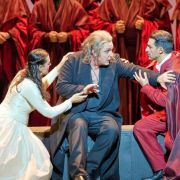
Twenty-five years: the time it takes the beleaguered Simon Boccanegra to find his lost daughter and make peace with his enemies, in the hopes of ushering in a more serene age. After almost the same epochal length of time, Peter Stein’s production at the Wiener Staatsoper offers vastly more mundane and less fruitful results in its staging of Verdi’s belatedly reformed masterpiece.

In the current landscape of the Staatsoper’s productions, Stein’s 2002 staging is distinctly of a different era. Stefan Mayer’s sets opt for a minimalistic design, offering stark distillations of the scenes’ settings (the only, rather baffling divergence from this is the Council Chamber’s painted backdrop), coloured atmospherically by the lighting. The results are sometimes quite striking, as in the claustrophobic, hauntingly lit chamber of Act 2, while at other places they only achieve workmanlike effectiveness. The long set changes also rather put a damper on the drama. Moidele Bickel’s monochromatic, stylised costumes provide historical veneer without overblown grandiosity, complementing the staging’s handsome, inoffensive design – a sleek framework that could allow heightened focus on the drama.

The direction of the stage action, however, was sorely lacking. Much of the revival’s slackening tension may be ascribed to repertory routine rather than whatever concept Stein created a quarter of a century ago. Ultimately though, the result remained unsatisfactory: much of the acting defaulted to rudimentary gestures and movement, offering vaguely sketched depictions of characters and relationships that each cast member colorued according to their talent. The chorus fared worse. For a work where the power of il popolo is of tantamount importance and warring factions clash ceaselessly, the crowd scenes remained static and dramatically unconvincing, rarely conveying the tension and turmoil so clearly evident in the score.
Yet for any misgivings about the staging, a sorer issue was the uneven performance of its title role. Ludovic Tézier is more than a known quantity as Boccanegra – his recent recording leaves little doubt as to his mastery of the role. This run, however, found his baritone in a weathered state, the top lacking the force and richness necessary for a commanding performance, resulting in a rather pallid Council Chamber scene (though his command to Paolo was delivered with startling darkness). To Tézier’s credit, his performance in Acts 2 and 3 as the tormented, unravelling leader was gripping, vividly phrased and devastatingly moving throughout, ideally matched in dramatic intensity by Kwangchul Youn’s Fiesco and Federica Lombardi’s Amelia. Indeed, the latter was the clear standout of the evening.

Lombardi shone with undimmed brilliance as a headstrong, passionate Amelia Grimaldi. From an opening golden-hued, dreamy “Come in quest’ora bruna” onwards, Lombardi’s sumptuous, gleaming tone and sensitive phrasing offered a magnetic assumption of the role, equally commanding and affective vocally and scenically, especially touching in her interactions with Tézier’s Boccanegra. Charles Castronovo’s Gabriele Adorno amply matched her passion, although not her nuance. Castronovo’s darkened timbre and forceful tone is a matter of taste, and his dynamic shading leaves something to be desired (his ardent “Sento avvampar” leaned more towards verismo than bel canto), but he gave an altogether convincing account of the young, rebellious patrician. Kwanghul Youn’s Fiesco, though a touch worn in tone, thundered with resounding authority and wounded pride, anchoring his scenes with ample gravitas.
A good Boccanegra needs a good Paolo to scheme, intrigue and wreak havoc, setting the fateful drama in motion and keeping it moving every step of the way: in short, an Iago in the making. The ensemble’s own Attila Mokus was unfortunately too light in weight and tone for the task, short on the dripping, growling malice that one would expect in this role (although his tempting of Fiesco and Adorno in Act 2 was, at least, perfectly devious).

Happier were the matters in the pit: with Marco Armiliato at the helm, the orchestra’s performance was beyond reproach. Armiliato conducted with genuine feel for the drama in a well-paced and passionately phrased reading, luxuriating in the gentler, luscious orchestral passages and the frenetic outbursts without becoming self-indulgent, making Boccanegra’s integral connection to the late Verdian masterworks readily apparent. The orchestra’s warm, rich tone and inspired, highly dramatic playing thrilled throughout, especially in moments like the Act 1 finale’s curse, dipping into the oozing darkness of the score. If Stein’s staging leaves the dramaturgical difficulties of Verdi’s much-reworked opera clearly on display, the Staatsoper’s forces allow for no doubts about the musical genius of Simon Boccanegra.