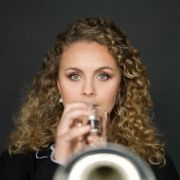
American composer Nico Muhly wrote his trumpet concerto Doom Painting for Tine Thing Helseth, and three days after Helseth, the Hallé and conductor Alpesh Chauhan gave its UK premiere in Manchester, these forces introduced the work to the hardy few who made up the Sheffield audience for this concert. It’s a piece which largely avoids the militaristic fanfares conventionally associated with the trumpet, focusing instead on the instrument’s reflective qualities. Though Muhly has given some explanation of the concerto’s backstory, in exploring the trumpet’s depiction in a variety of biblical contexts, those narratives were not much in evidence in practice, at least on an initial hearing.

Two things stood out. One was the music’s evident American origins, the hints of Copland and all those who followed him in using the trumpet to evoke wide open spaces. The other was its filmic quality, particularly in the opening movement, in which the trumpet line mused rhapsodically over a shifting bed of orchestral sound. The slow movement was the most compelling of the three. Curiously, given that Muhly describes this section as a response to “sacred wall-paintings depicting the last judgment and the end of the world”, it was at this point that the piece felt most consolatory, strings and a prominent part for celesta creating a dreamy backdrop for the trumpet’s song. The finale, a nod to the trumpet’s role in the Psalms, notably Psalm 150, was joyful, allowing Helseth and the two orchestral trumpets to engage in some celebratory gymnastics en route to the work’s somewhat abrupt ending.


If the doom depicted in Muhly’s piece was eschatological, its equivalent in Walton’s extraordinary Symphony no. 1 in B flat minor was entirely personal. The story of its first three tortured movements, a response to Walton’s disintegrating relationship with Baroness Imma Doernberg, and the belated addition of a finale, coinciding with Walton’s new romance with Lady Alice Wimborne, is well known. Performances like the one Chauhan and the Hallé delivered here make a persuasive case for this being Walton’s greatest work, at least in orchestral terms.
Not that this was a consistently compelling reading. Unusually, given the first movement’s largely unrelenting rhythmic pulse, other performances have emerged as much more driven here, but the Scherzo fizzed with appropriate malice and the slow movement was full of anguish and regret. Principal flute Sarah Bennett hit the ideal note of desolation in the solos that open and close this movement, sounding for all the world like the considerably more existential woe of Walton’s contemporary Shostakovich.
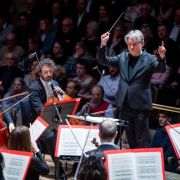
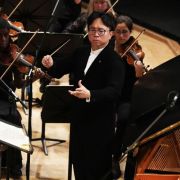
But it was the finale, unusually, that was the most powerfully convincing: not so much the rhetorical pomp of Walton in ceremonial march mode, but more a composer wrestling a hard-won victory out of the knotty fugal passages and the solemn ‘last post’ poignancy of the trumpet solo in the epilogue, before the twin timpanists with their choreographed flourishes led the music to its triumphant close. The Hallé’s brass section was superb throughout. Chauhan gave a genuinely full-bodied lead from the podium, balletic and sweeping of gesture, and indeed being literally airborne a couple of times in the closing bars of the first movement.


If the concert ended in full-blooded affirmation, its curtain-raiser struck a much more ambivalent tone. Britten’s Courtly Dances, from his opera Gloriana, are clearly not authentic 16th-century pavanes and galliards, but neither are they ironic 20th-century pastiches of these forms. Instead, perhaps like Britten himself, they remain inscrutably masked. The Hallé gave a performance of precision and elegance but, like the music, kept something in reserve.