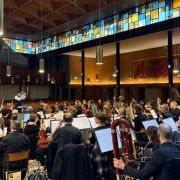
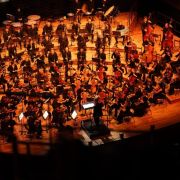
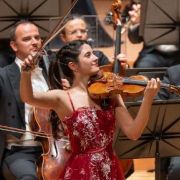
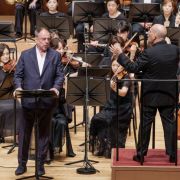
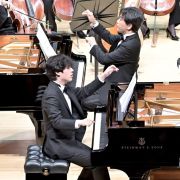
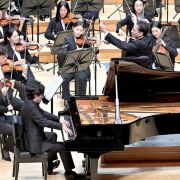
At Seoul Arts Center, Myung-whun Chung and the KBS Symphony Orchestra gave a Mahler evening whose finest moments grew from sustained quiet. Christiane Karg set that scale in the Rückert-Lieder. Her soprano was finely shaded, the diction clear, individual words inflected with a recitalist’s care. Chung kept the accompaniment responsive and discreet, allowing the poetry to carry its own expressive weight. The intimacy held across the orchestral setting, Karg’s phrasing drawing the listener towards the text.

The Fourth Symphony initially felt more guarded. Chung gave the opening movement broad phrasing and a yielding pulse, shaping its lyrical contours with characteristic rubato. The orchestra followed these inflections with conspicuous care, yet the flow between phrases sometimes stiffened. One sensed the effort of accommodating each adjustment, and the movement’s conversational ease suffered. At moments, the music seemed to wait for permission to move. The sleigh bells sat back in the balance, softening the opening’s bright, slightly disquieting edge. Greater rhythmic buoyancy would have helped the music move more freely through its changes of mood. Chung’s expressive intentions were clear; the players needed greater ease within them, allowing detail to settle into the larger movement of the phrase.


The Scherzo carried a similar caution. Mahler’s solo violin, tuned a whole tone higher, introduces a wiry, estranged voice into the dance. Its exchanges with the gentler trio episodes depend on a mobile interplay of rhythm and colour. Here the dance lacked lift, while the lighter passages remained too carefully shaped to acquire much playful freedom. More lilt in the phrasing and greater suppleness of colour might have released the movement’s capricious imagination. Its oscillation between the macabre and the ingenuous felt inhibited, the changes of character insufficiently animated. Across these opening movements, the refinement suggested fine tea after repeated infusions: a trace of fragrance still rose from the cup, though the flavour had begun to pale.

In the Poco adagio, Chung and the orchestra found a common breath. The softest playing retained a centred tone, and long phrases held tension across their full span. Dynamics could fall to the edge of audibility while the line remained supported. Chung’s rubato was absorbed into that continuity, the orchestra responding with an ease that had been elusive earlier. His broad conception now seemed sustained from within the ensemble. The players inhabited the space he opened within each phrase, creating an atmosphere of unusual suspension. The music’s repose held a fine pressure beneath it. When the great E major outburst arrived near the close, that reserve of tension gave its radiance force and scale. The climax felt proportioned to the quiet that had prepared it. In this stillness, the pale infusion could be savoured to its last trace, its depth gathering in the aftertaste.


Karg returned for Das himmlische Leben with cultivated poise. The warmth of her soprano gave Mahler’s heavenly narration a human presence, though it also placed a slight distance between the singer and the child’s unselfconscious wonder. Her assurance was evident; the emotional perspective occasionally suggested innocence recollected from adulthood. The slow movement remained the evening’s strongest achievement, where the orchestra inhabited Chung’s phrasing with complete conviction, and the quietest sound carried the longest reach.