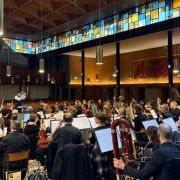
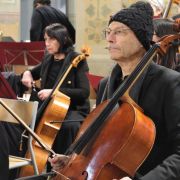
The Bachische Collegium Musicum was founded in Leipzig by Georg Philipp Telemann in 1702; the ‘Bachische’ aspect came later, when Johann Sebastian Bach took over the directorship in 1729. Such collegia were informal associations of music-makers in intimate venues like coffee houses, producing free concerts involving many now famous names. This delightful concert from the Bach Akademie Australia at ACO on the Pier celebrated the Leipzig version with some well-known examples intermingled with charming rarities.

The first half was bookended with sections of Telemann’s Tafelmusik, beginning with the overture. A small ensemble of historical instruments (four violins, viola, cello, double bass and harpsichord) under the direction of violinist Madeleine Easton also featured two flutes. The sonorous sounds of the gut strings are always welcome, and the fleet fingers of the flautists (Mikaela Oberg and Jessica Lee) were a lovely contrast.


As usual, Easton provided an erudite, entertaining and enthusiastic commentary. She introduced the second item by discussing Vivaldi’s influence on Bach and Telemann, then led a smaller string group in the former’s version of La Follia, featuring her own expressive playing and some nimble cello work from an equally expressive Anthea Cottee. The spotlight then switched to harpsichordist Nathan Cox for a rippling rendition of the Allegro from Bach’s Concerto in F major arranged for solo keyboard from Vivaldi’s RV 310.
Then came one of the unusual items, a Sinfonia in G minor by Johann Friedrich Fasch. One of Bach’s contemporaries, Easton commented that he represented “a new world coming”, leaning more to the Gallant than the Baroque style. This work involved the full string ensemble, with a dramatic Allegro heralded by three emphatic chords calling for attention, followed by a lyrical Andante, a fugal Alla breva, concluding with a cheerful Allegro with dramatic accents. The first half concluded with the conclusion of Telemann’s Tafelmusik, Part I, with the return of the virtuosic flutes.

After the interval, Easton ceded the spotlight to violinist Simone Slattery, who suggested that during the Baroque era, “they could be rather silly”. This was by way of an introduction to Telemann’s Violin Concerto in A major, “Imitiert die Relinge” (The Frogs). In the first Allegro, the lead violin (Slattery) in particular produced a throaty sound like a croaking frog, echoed by the other players, and especially the viola (John Ma) in the succeeding (even sillier if anything) Adagio. In the last movement, it seems the frogs have hopped off, leaving the players to produce a quite sensible Menuet. One’s enjoyment was greatly enhanced by the evident good time being had by the musicians, in particular Slattery who produced a variety of entertaining facial expressions.


A more purely musical experience ensued with Bach’s Trio Sonata in F major, arranged for flute (Oberg), violin (Easton) and harpsichord by Elizabeth Walker from the Organ Sonata no 1, BWV525. This was beautifully played and apparently effortlessly, although Easton commented afterwards that it was “insanely difficult”. The last item on the programme was a familiar Bach work, the Concerto in D minor for two violins, BWV1043, with Easton and Slattery leading the strings in another fluidly graceful display of the collaborative focus of this exemplary ensemble.