Tiler Peck choreographed her first piece for New York City Ballet in 2024. Concerto for Two Pianos (set to Poulenc’s tuneful piece) was not groundbreaking, but it was a genuine delight. Had a mix of fun allegro work and a dreamy adagio duet. It revealed Peck to be a choreographer of taste and charm.

Expectations were thus very high for Symphonie Espagnole. Peck’s sophomore effort was a considerably more ambitious work, with five movements, 40 dancers, and a structure that Peck admits was inspired by Balanchine’s Symphony in C.
So how is Symphonie Espagnole? It’s an ambitious, sprawling ballet without the cohesiveness of her earlier ballet. Édouard Lalo’s violin concerto is a considerably denser, thornier work than the Poulenc. The steps flow less easily from the music.
One head-scratcher was the decision by costume designer Robert Perdziola to mix-and-match the costume styles. In the first movement, the corps and soloists wear big fluffy tutus. In the second movement, everyone is in sleek cocktail-length dresses. In the third movement, the men are in old-fashioned vests and white tights. Fourth movement, back to the cocktail-length dress style. The color scheme is odd too – different shades of red. As a result, the five movements had a disjointed look, like the several different ballets wandered onstage together rather than one unified vision.


As for the steps, Peck is more skilled choreographing for the soloists than the corps. The first movement, with its formal tutu look and steps that resemble classroom exercises for the corps, fared the worst. It looked like filler, and although Indiana Woodward and David Gabriel were fine, they seemed superfluous.
The second movement is my favorite. Kloe Walker does a series of folk-inflected steps, including the iconic Kitri jumps. Walker is dark-haired, glamorous, with a winning stage presence. She has a light, airy jump. The all-female corps mirror her movements. I liked the way Peck had the corps use their arms in a delicate, lyrical way. It has an authentic Spanish feel.
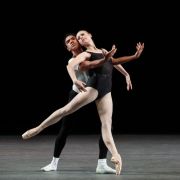
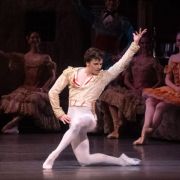
In the third movement, Roman Mejia and the all-male corps do a series of steps that look flamenco-inspired, replete with stomps. Mejia also does some bravura turns and jumps. The fourth movement has Mira Nadon and Ryan Tomash dancing a moody, darkly-lit pas de deux that resembles the look and feel of the adagio in the Poulenc piece, down to the maroon dress and blue lighting. Nadon and Tomash were mysterious and sensuous.

The main problem with the ballet, however, is the finale. The music does not really crescendo to a thrilling conclusion. It’s a quieter ending, so Peck’s decision to flood the stage with the forty dancers in a Balanchinean finale does not have the same impact. Peck also seems lost on how to coordinate the forty dancers. The different movements do come onstage for their dance, à la Symphony in C. But If you compare the finale to the way Balanchine could move groups in Western Symphony or Diamonds, the lack of buildup and structure are more obvious.


The positives: Peck is not afraid of sticking to classical steps and using classical music. It’s a very different feel than the neoclassical/modern mishmash that so many NYCB premieres are nowadays. She has an eye for creating steps that suit the talents of her dancers. It just didn’t come together as much as it could have in this ballet. If Symphonie Espagnole reminds me of anything, it’s the movie Marty Supreme, which was also a movie with a surfeit of big ideas, not all of them fully realized.

The program was oddly constructed. Opus 19/The Dreamer received a strong performance from Joseph Gordon and Alexa Maxwell. Both of them conveyed the moody, surreal quality of the piece very well. Maxwell has a way of articulating the spiky angularity of the arm movements and inflecting each phrase with a sense of yearning. Gordon’s style is softer, more inward. They made a good pair. Putting Opus 19/The Dreamer on the same program as Alysa Pires’ rather dark, clinical Standard Deviation was an inexplicable choice.
Just too much blue light and sadness for one program.