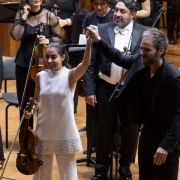
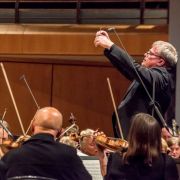
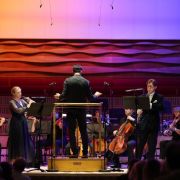
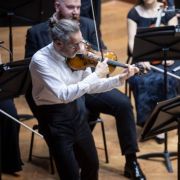
The centrepiece of the Royal Liverpool Philharmonic Orchestra’s Sunday matinee under Domingo Hindoyan was a performance of Prokofiev’s Piano Concerto no. 2 in G minor. Premiered it in 1913, the score was destroyed in a fire after the Russian Revolution. Prokofiev rewrote it and performed the substantially revised version in 1924. It is reputedly one of the most technically demanding of all piano concertos; even the composer had difficulty with it when he returned to it in the 1930s. This afternoon’s soloist was Alim Beisembayev who gave no sign of struggling with the material; his was a bravura performance.


I was glad to have had a good view of the pianist’s fingers flying all over the keyboard (did he really only have two hands?) but the virtuoso display was only part of the story. One felt that he was expressing the inner meaning of the music as well as entertaining and playing with the audience. Beisembayev clearly has a fine rapport with the RLPO. The give and take between him and Hindoyan was evident, for example at the end of the first movement where, after a long and dazzling cadenza the whole orchestra joined in with a joyful outburst and then a brief reprise of the gentler music from the beginning of the concerto. Not that there is much gentle music in this concerto, nor much respite for the soloist. The relentless Scherzo gave him hardly a moment’s pause.
Beisembayev really responded to Prokofiev’s peculiar musical idiom as was obvious from the obsessive, driving rhythms of the third movement. In the finale Hindoyan ensured that the orchestra supported the soloist without ever overpowering him, Beisembayev dispatching another stunning cadenza. Surely he would not want to play an encore after that? But no, he gave us a beautiful, atmospheric account of Debussy’s Reflets dans l’eau. A total contrast!


The concert had opened with Rimsky-Korsakov’s Russian Easter Festival Overture, a sparkling work referencing the pagan origins of Easter as well as Russian Orthodox liturgical chants. The spotlight moved from one group of instruments to another, demonstrating the skills of the RLPO players. The evocation of bells by the harp, glockenspiel and triangle was particularly effective.
The second half of the concert was devoted to one of the most popular and frequently played of all symphonies: Tchaikovsky’s Fifth. However well known it may be, it can rouse and move an audience and this afternoon Hindoyan gave us an exciting, heartwarming account. The very opening with low strings and woodwind to the fore set the scene with anticipation of what was to come and built up the excitement throughout the movement, and then there was a change of mood with the lovely horn solo of the Andante cantabile. Often I was struck by how Hindoyan managed not just the sounds but the pauses between them. The third movement Waltz had elegance and lightness; the finale moved to a glorious, magnificent conclusion completing a very satisfying concert.